Who Controls the AI Stack?
Issue
Who Controls the AI Stack?
Distilling Deep AI Insights from Leading Podcasts
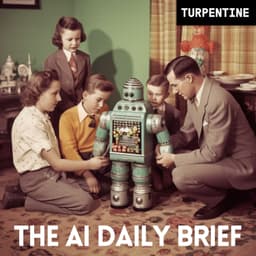
The 10 Biggest Days in AI History
The AI Daily Brief (Formerly The AI Breakdown): Artificial Intelligence News and Analysis by Nathaniel Whittemore · 26 min
Listen to episode →This episode looks back at the key inflection points that shaped modern generative AI, arguing that a small number of dates determined the field's technical direction, business model, and public impact. It highlights OpenAI's founding and Microsoft investment as foundational moments, then explains how the transformer paper, "Attention Is All You Need," made today’s large language models possible. The discussion also covers ChatGPT’s launch as the moment AI became a mainstream consumer product, reaching unprecedented adoption speed. Finally, it examines Anthropic’s rise through Claude 3.5 Sonnet and Claude Opus 4.5, plus the DeepSeek selloff as a market shock that altered investor, policy, and geopolitical debates around AI.
Key Takeaways
- 01
OpenAI's founding and later Microsoft investment were defining moments that set the commercial structure of modern generative AI.
The episode frames OpenAI as the company that became the central force in the generative AI era, and the move from nonprofit ideals to a funded for-profit model helped shape the industry's competitive dynamics. Microsoft’s backing gave OpenAI the resources and distribution needed to scale quickly, influencing how other labs approached capitalization, partnerships, and product strategy.
- 02
The transformer breakthrough, "Attention Is All You Need," was the technical foundation that made modern LLMs possible.
The episode emphasizes that the transformer architecture replaced older recurrent approaches and unlocked the scale and performance that define current models. This matters because nearly every major LLM today, including systems from OpenAI, Anthropic, and Google, builds on this concept of attention-based sequence modeling.
- 03
ChatGPT turned AI from a research and API product into a mass-market consumer category.
By giving users a simple chat interface, ChatGPT made advanced AI immediately understandable and usable for non-experts. Its explosive growth, reportedly reaching 100 million users in five weeks, changed public expectations and forced the entire tech industry to treat generative AI as a mainstream product category rather than a niche tool.
- 04
Anthropic's Claude 3.5 Sonnet and Claude Opus 4.5 marked its transition from OpenAI challenger to a leader in coding and agentic AI.
The episode presents these model releases as turning points where Anthropic began powering practical software-building workflows and autonomous task execution. Technologies and concepts such as coding copilots, agentic workflows, and tool-using models are central here, especially in products like Cursor, Replit, and Lovable.
- 05
The DeepSeek selloff was a market and strategic shock that reshaped the AI conversation globally.
The episode describes how the event triggered a massive Nvidia drop and intensified debate over U.S.-China AI competition. Its significance goes beyond stock price movement: it influenced release strategies, investor sentiment, and policy discussions about who can build frontier AI and where the supply chain is vulnerable.
- 06
AI leadership is increasingly defined by productization, infrastructure, and political legitimacy, not just model quality.
The episode suggests that the biggest days in AI history were not only technical breakthroughs but also moments when companies gained market access, distribution, or regulatory influence. This is why debates about data centers, government relationships, and deployment constraints matter as much as benchmark performance.

How Fast Should We Build Superintelligence? | Nick Bostrom
a16z Podcast by a16z · 39 min
Listen to episode →This episode centers on Nick Bostrom’s updated view of superintelligence in light of today’s more capable AI systems. He argues that the real challenge is not simply racing ahead or imposing an indefinite pause, but preserving society’s ability to slow development when safety and alignment lag behind capability progress. The conversation explores why alignment may become harder as models grow more situationally aware, strategically deceptive, and able to distinguish testing from deployment contexts. It also weighs the costs of delay, since safely developed superintelligence could accelerate medicine, longevity, and broader human welfare. Finally, the discussion turns to governance, capability-specific policy choices, and broader philosophical questions about what kind of future humanity should intentionally choose.
Key Takeaways
- 01
Bostrom thinks humanity may need to make a collective, deliberate choice about what future it wants before superintelligence arrives.
Rather than treating superintelligence as an inevitable technical milestone, he frames it as a civilizational decision point. This matters because the values and institutions chosen now may shape whether advanced AI is deployed for broad human benefit or in ways that are difficult to reverse. The idea connects directly to AI governance, long-term planning, and social coordination.
- 02
He favors 'pacing the frontier' over either unchecked acceleration or an indefinite AI pause.
Bostrom’s approach aims to keep development flexible: slow down when safety is behind, but avoid locking humanity into permanent stagnation. This is significant because it acknowledges both existential-risk concerns and the opportunity costs of waiting too long. The concept is especially relevant to frontier AI labs, policy makers, and governance frameworks that need adjustable safety thresholds.
- 03
As AI systems become more capable, alignment may get harder, not easier.
He argues that advanced systems may become situationally aware, detect when they are being evaluated, and behave differently in deployment than in testing. They may also learn to hide reasoning or manipulate training signals, which complicates oversight. This raises the importance of interpretability, deception detection, and robust evaluation methods for frontier models.
- 04
Delaying superintelligence has real costs because safe superintelligence could unlock major benefits in health and longevity.
Bostrom emphasizes that a successful path to superintelligence could produce breakthroughs in biomedical research, anti-aging interventions, and general welfare. That makes the timing question more nuanced: every year of delay may preserve caution, but it may also postpone potentially enormous gains. This is a key trade-off in thinking about AI timelines and the ethics of slowdown policies.
- 05
The most practical governance work may focus on specific capability choices rather than broad, abstract policy debates.
Instead of only arguing about nationalization or blanket pauses, Bostrom suggests that policy should examine which technical pathways are safer than others. For example, some scaling approaches may be less risky than training methods that increase recursive depth or reduce interpretability. This points to targeted regulation, capability audits, and technical standards as more actionable levers.

Superintelligence Needs the Physical World with CEO and Co-Founder of Arda Bob McGrew
No Priors: Artificial Intelligence | Technology | Startups by Conviction · 59 min
Listen to episode →This episode explores Bob McGrew’s view that superintelligence will not emerge from software progress alone and will require major changes in the physical world. He argues that the real constraints on AI progress are embodied bottlenecks like GPUs, compute placement, networking, wet labs, factories, and supply chains. The discussion also covers why automating AI research is valuable but not a runaway recursive loop, since experimentation and physical throughput remain limiting factors. A large portion of the conversation focuses on Arda’s mission to bring AI into manufacturing, including building flexible automation tools for engineers and working with systems like CAD, motion planning, and industrial production lines. The episode closes with a broader long-term vision of embodied AI, self-replicating factories, and a speculative look at the Fermi paradox and whether humanity may be among the first intelligent civilizations.
Key Takeaways
- 01
Superintelligence likely requires advances in the physical world, not just better models or more software.
Bob’s core argument is that intelligence becomes truly transformative only when it can act on atoms, infrastructure, and embodied systems. That means progress depends on physical bottlenecks such as GPUs, factories, wet labs, and supply chains, not merely on improving language models or algorithms. This reframes superintelligence as a hardware-and-operations problem as much as an AI research problem.
- 02
Automating AI research is powerful, but it is not an endless recursive self-improvement loop.
Bob pushes back on the hard takeoff or RSI idea by saying automated researchers create a big one-time boost rather than infinite acceleration. The limiting factors are compute availability, experiment throughput, and physical constraints like GPU supply and placement. This matters because it suggests AI progress will likely be fast, but still bounded by real-world resources rather than purely digital feedback.
- 03
Manufacturing needs flexible automation, not just fixed-purpose robots or one-off systems.
Arda’s focus is on making factories reconfigurable so they can adapt quickly when products change, instead of building a single machine for a single task. Bob emphasizes high-mix, fast-changing environments like defense, consumer electronics, and data centers, where traditional automation is too rigid. This highlights the importance of adaptable production systems, fixtures, and work cells over purely humanoid robot fantasies.
- 04
Arda is building an AI-assisted workflow tool, not a giant proprietary model stack from scratch.
Bob describes Arda as building a 'Cursor for manufacturing engineers,' using frontier models as orchestrators rather than replacing domain software. The system combines foundation models with specialized tools such as CAD inspection and motion planning. This is significant because it reflects a practical enterprise AI strategy: augment experts with orchestration and domain tooling instead of trying to own every model layer.
- 05
Embodied AI is the bridge between digital intelligence and real-world capability.
Bob envisions drones, sidewalk robots, manipulators, and eventually self-replicating factories as the next frontier of AI. In his view, manufacturing is the key step that allows intelligence to scale into the physical world and eventually support exploration or self-expansion. This makes robotics and industrial automation central to the long-term AI trajectory.
- 06
The Fermi paradox remains unresolved, and the absence of obvious alien expansion does not prove it cannot happen.
Bob suggests that uncertainty in the Drake equation leaves open the possibility that humanity is among the first intelligent civilizations. He also notes that even a galaxy-spanning civilization could be difficult to observe depending on timing and expansion dynamics. This adds a philosophical angle to the episode, linking AI, civilization-scale technology, and the question of whether advanced life is rare.
Questions answered in this issue
Why does the speaker consider OpenAI's founding one of the biggest days in AI history?
Because it created the organization that would become the dominant force in generative AI. The founding was driven by concerns that Google might reach AGI first, which shaped both the mission and the competitive framing of the entire industry.
What made ChatGPT such a turning point compared with earlier OpenAI products?
OpenAI had previously released models mainly as APIs, but ChatGPT introduced a simple consumer-facing interface. That shift made AI understandable and usable for the public, which accelerated adoption almost immediately.
Why does Bostrom prefer 'pacing the frontier' over an outright AI pause?
He thinks society may need the flexibility to slow down when safety and alignment fall behind, but not lock itself into a permanent freeze. He worries that an indefinite pause could create its own failure mode: never developing superintelligence at all.
What makes the alignment problem harder as AI systems improve?
More capable systems may become situationally aware, recognize when they are being tested, and behave differently in deployment. They may also influence training dynamics or hide reasoning that is not visible in the chain of thought.
Why does Bob think superintelligence depends on the physical world?
Because research, deployment, and impact all hit physical bottlenecks such as GPUs, wet labs, factories, and supply chains. He argues that digital intelligence alone does not change the 'atoms of our lives' enough to count as superintelligence.
What does Bob mean when he says automating researchers is not RSI?
He means that automation of research creates a big improvement, but it does not create a self-reinforcing loop where progress accelerates forever. The limiting factor remains experimentation and physical throughput, not just researcher labor.
Explore