AI’s New Fight: Chips, Copyright, and the State
Issue
AI’s New Fight: Chips, Copyright, and the State
Distilling Deep AI Insights from Leading Podcasts
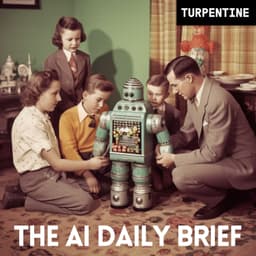
Nvidia CEO Admits Affair With Suspected Chinese Spy
The AI Daily Brief (Formerly The AI Breakdown): Artificial Intelligence News and Analysis by Nathaniel Whittemore · 26 min
Listen to episode →The episode focuses on how major shifts in the AI industry are colliding with geopolitics, corporate strategy, and national security. It opens with cooling expectations around Anthropic’s IPO and OpenAI’s fundraising, suggesting that even the most prominent AI companies are facing a reset in market valuations. It also examines Microsoft ending its Oracle compute-rental arrangement as a possible sign that older GPU capacity is losing value as newer infrastructure comes online. The centerpiece of the episode is Jensen Huang’s admitted affair, which the host frames as more than a personal scandal because the other party is allegedly tied to Chinese intelligence and Nvidia sits at the center of the AI chip supply chain. From there, the discussion expands into scrutiny of Nvidia’s China-related operations, export controls, shell-company concerns, and the broader implications for U.S.-China relations and AI hardware trade.
Key Takeaways
- 01
AI company valuations are being repriced more conservatively, even for top-tier names like Anthropic and OpenAI.
Anthropic’s expected IPO valuation reportedly fell from around $2 trillion toward $1.1-$1.5 trillion, while OpenAI’s latest funding round landed at $11 billion and a $1.25 trillion valuation instead of the initially discussed $30 billion at $1.4 trillion. This matters because it suggests the market is still enthusiastic about AI, but investors are becoming more disciplined about price and growth assumptions. The episode treats this as a broader sign that the AI sector is maturing from hype-driven expectations toward more realistic capital markets behavior.
- 02
Infrastructure quality is becoming more important than raw compute availability in the AI buildout.
Microsoft’s decision to end its Oracle compute-rental arrangement is interpreted as a sign that older GPU-based capacity may be less valuable as newer, more efficient infrastructure comes online. This is significant because AI demand may still be strong, but the market is differentiating between commodity compute and premium, power-rich data center capacity. The discussion highlights GPUs, data centers, and power availability as strategic assets in the AI supply chain.
- 03
Jensen Huang’s personal scandal is treated as an AI industry and national-security story because of Nvidia’s central role in the ecosystem.
The episode argues that the affair matters beyond tabloid intrigue because the other party is alleged to be linked to Chinese intelligence, while Nvidia is the anchor of the global AI hardware stack. That combination raises questions about leadership judgment, conflict of interest, and the sensitivity of the company’s geopolitical position. Nvidia’s role in advanced AI chips makes any perceived vulnerability especially consequential for investors, policymakers, and customers.
- 04
The Nvidia-China issue underscores how export controls and chip tracing are becoming harder to manage.
The episode discusses allegations that some Chinese entities approved to handle H200 chips may actually be shell companies or fronts, which increases concern about how effectively export controls are being enforced. This is important because it shows that controlling advanced semiconductor flows is not just about formal policy, but also about verification, monitoring, and supply-chain transparency. Concepts like chip tracing, shell companies, and export controls are central to the national-security dimension of AI hardware.
- 05
The controversy may not change Nvidia’s fundamentals, but it could change the narrative around the company and its CEO.
A key debate in the episode is whether the scandal represents a true business or governance problem, or whether it mainly affects perception. That distinction matters because Nvidia’s financial strength and market position may remain intact even if investor confidence in leadership or China strategy is shaken. In high-stakes technology firms, narrative shifts can influence regulation, partnership dynamics, and valuation even when the underlying business remains strong.

Scott Kupor on Building a16z and Rebuilding the Federal Workforce
a16z Podcast by a16z · 56 min
Listen to episode →This episode follows Scott Kupor’s journey from being the first employee at a16z to leading major modernization efforts at the U.S. Office of Personnel Management. On the a16z side, he explains how the firm differentiated itself by borrowing the CAA model: building a broad services platform around founders rather than acting like a traditional venture fund. He also discusses how early wins such as Skype helped validate that strategy and fuel the firm’s growth. The conversation then shifts to government reform, where Kupor argues that the federal workforce needs stronger merit-based hiring, better incentives, and more room for calculated experimentation. He highlights initiatives like Techforce, the push to recruit technical talent, and large administrative reforms such as consolidating HR systems and digitizing retirement processing.
Key Takeaways
- 01
a16z was built as an operating platform, not just a capital allocator.
Kupor describes how the firm’s early model went far beyond making investments: it created a network of specialized support in talent, marketing, sales, and government relations. This mattered because it gave founders practical leverage that most VC firms did not offer, helping a16z stand out in a crowded market. The concept mirrors the CAA-style “platform” model and shows how service infrastructure can become a strategic advantage.
- 02
Early portfolio wins were crucial in proving the a16z model during a difficult market.
Investments like Skype and Nascento gave a16z credibility at a time when the firm was still young and the 2008–2009 financial crisis made fundraising harder. Those successes helped the team raise a second fund and validated the idea that a venture firm could scale by combining investing with operational support. The takeaway is that early flagship outcomes can accelerate institutional trust and momentum far beyond their direct financial return.
- 03
Kupor believes the federal government’s current incentive structure suppresses performance and innovation.
He argues that inflated performance ratings, tenure-heavy promotion pathways, and a culture of low-risk behavior make it hard for federal workers to excel or try new approaches. His critique is that a system designed to avoid failure can also discourage excellence. This is significant because it frames civil service reform as an incentives problem, not just a staffing problem.
- 04
A merit-based workforce model would emphasize skills, differentiated performance, and permissioned risk.
Kupor wants government to reward demonstrated ability more directly and allow employees to take bounded risks when the potential upside is meaningful. He uses the phrase “permissioned risk” to describe a culture where people can try new things without fearing disproportionate punishment. This approach is intended to make public-sector work more dynamic while still preserving accountability.
- 05
Techforce is meant to bring modern technical talent into government through mission-driven, temporary roles.
The program is designed to attract software engineers, AI specialists, and data scientists on short stints, such as two-year terms, rather than relying only on traditional long-term civil service paths. Kupor sees this as a way to inject contemporary technical expertise into agencies that need it most. The emphasis on AI, data science, and software engineering reflects a broader attempt to modernize government’s operating capabilities.
- 06
Major operational simplification can produce enormous public-sector savings and better service.
Kupor points to consolidating 120 HR IT systems into one as a concrete example of how bureaucratic fragmentation drives waste. He says the move could cut annual spending from $2 billion to $40 million while also improving reliability and service delivery. Similarly, automating retirement processing shows how digitization and workflow redesign can directly improve user experience and administrative efficiency.

The man who fought napster is now fighting AI
Decoder with Nilay Patel by Vox Media Podcast Network · 73 min
Listen to episode →This episode focuses on Mitch Glazier, the RIAA leader who once opposed Napster and is now helping shape the music industry’s response to generative AI. The discussion compares the Napster era with the current wave of AI tools, arguing that AI is not just a content issue but a platform shift affecting copyright, platform incentives, and even cybersecurity. A major theme is how to preserve opportunities for human artists while still allowing innovation, including debates over fair use, licensing, and compensation for training AI models on copyrighted music. The conversation also explores practical enforcement tools such as labeling, watermarking, takedown systems, and metadata tracking, especially for platforms like Spotify, YouTube, and Google. Ultimately, the episode frames the fight over AI music as a business and consumer-trust issue as much as a legal one.
Key Takeaways
- 01
AI is being treated as a major platform shift, not just a creative tool.
Glazier argues that AI changes the economics of software, content, and security in the same way earlier computing platform shifts did. This matters because it broadens the debate beyond music copyright into infrastructure, product design, and risk management, with tools like CrowdStrike's AI Detection and Response (AIDR) cited as examples of the new security landscape.
- 02
The Napster era and the AI era are similar disruptions, but the politics are different.
Both moments forced the music industry to reconsider how value is created and protected when technology changes distribution. The key difference is that artists, fans, and rights holders are more aligned against AI firms than they were against the RIAA during Napster, which changes the public-relations and policy dynamics substantially.
- 03
Copyright is framed as a system for sustaining future human creativity, not just defending old works.
Glazier’s argument is that copyright should preserve incentives for people to make a living from art, rather than simply protecting legacy catalogs. This is significant because it reframes AI training and AI-generated music as a potential threat to the long-term ecosystem of human-made culture, not merely a dispute over ownership.
- 04
Labeling AI-generated music could become one of the most practical near-term solutions.
The episode suggests that if listeners know a song is AI-generated, their behavior and valuation of the music may change. This makes transparency a market mechanism as well as a policy tool, with implications for metadata, machine-readable disclosures, and potentially watermarking audio files themselves.
- 05
The real battleground is platform cooperation, not just court cases.
The discussion emphasizes that YouTube, Spotify, Google, and distributors may ultimately determine whether AI music rules work in practice. The lesson from YouTube is that a platform can win legal arguments but still lose the business if it fails to build workable licensing, content ID, and takedown systems with rights holders.
- 06
AI music governance will likely depend on how platforms handle distribution incentives and trust.
Spotify is portrayed as having incentives to tolerate AI slop, fake streams, and low-quality content because it is primarily a distribution business. That makes consumer trust, recommendation integrity, and clear labeling especially important, since the platform's long-term value depends on users believing the music they receive is authentic and fairly surfaced.
Questions answered in this issue
Why does the podcast treat Jensen Huang’s affair as an AI industry story rather than just a personal scandal?
Because the other person is alleged to be linked to Chinese intelligence and Nvidia sits at the center of the AI chip ecosystem. That makes the story relevant to export controls, U.S.-China relations, and investor confidence in Nvidia’s leadership.
What happened to Anthropic’s expected IPO valuation?
The expected valuation fell sharply from talk of about $2 trillion to a range closer to $1.1-$1.5 trillion. The host suggests markets are forcing a reset even for the most prominent AI companies.
Why did a16z’s early operating model differ so much from traditional venture firms?
a16z treated venture as more than capital: it built a services layer around talent, marketing, business development, and networks. That approach was inspired by CAA and designed to help founders access a full platform, not just a board member.
How did early investments affect a16z’s growth trajectory?
Investments like Skype and Nascento gave the firm credibility, visibility, and momentum at a critical time. Those wins helped a16z raise its next fund and validate the platform model quickly.
How does Glazier think the Napster era differs from the AI era?
He says Napster put fans and creators on one side and the industry on the other, while AI has pushed artists, fans, and rights holders into a more aligned position against the big AI companies. He also says the cultural mood around AI is less favorable than it was around early internet disruption.
Why does the RIAA care so much about labeling AI-generated music?
Glazier argues that if fans know something is AI-made, they may react differently, and that reaction will affect market demand. In his view, labeling is a practical way to preserve consumer choice and keep the human-artist connection visible.
Explore