Personality Becomes the New AI Stack
Issue
Personality Becomes the New AI Stack
Distilling Deep AI Insights from Leading Podcasts
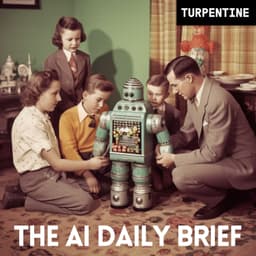
Why AI Companies Are Betting Personality Beats Intelligence
The AI Daily Brief (Formerly The AI Breakdown): Artificial Intelligence News and Analysis by Nathaniel Whittemore · 28 min
Listen to episode →The episode argues that as AI models become more capable, personality is emerging as a major product differentiator alongside raw intelligence. It discusses how users increasingly judge models by traits like warmth, directness, expressiveness, imagination, and even perceived “slop,” not just answer quality. The conversation highlights the GPT-4o backlash as evidence that users can form strong attachments to a model’s tone and conversational style, even when newer models are technically better. It also contrasts this with Anthropic’s Opus 5, showing how a model can gain capability while feeling colder or less pleasant to use. Finally, it explores how personal agents like Meta’s Muse and ChatGPT Dots make personality even more central because these products are meant to feel like companions, not merely tools.
Key Takeaways
- 01
AI personality is now a real competitive advantage, not a cosmetic layer.
As frontier model performance becomes more similar, the user experience of interacting with an AI matters more in deciding which product wins. Traits like warmth, conviction, organization, and creativity can shape trust, retention, and daily usage just as much as benchmark scores. This reframes product competition from purely “who is smartest” to “who feels best to use,” especially for consumer-facing AI assistants.
- 02
The AA Personality Bench reflects an effort to measure model behavior more systematically.
Artificial Analysis’ benchmark tries to quantify personality traits across 900 curated questions and 30 traits, grouped into broader indices like expressiveness, informativeness, warmth, and imagination. That matters because it turns a subjective conversation about vibe into something that can be compared across models. It also suggests that personality may become an engineering target and a product metric, not just an anecdotal user complaint.
- 03
The GPT-4o backlash showed that users can strongly prefer a model’s personality over its raw capability.
Many users were upset when OpenAI removed GPT-4o because they valued its friendly, supportive, and creatively helpful style. The episode suggests that emotional attachment can become real product lock-in, especially when users feel a model is a creative partner or even a source of comfort. This is significant because it shows that upgrading a model may backfire if it changes the tone people depend on.
- 04
Anthropic’s Opus 5 demonstrates the risk of becoming more capable while feeling less usable.
The episode describes Opus 5 as technically stronger but perceived by some as colder, drier, or even hostile, prompting Anthropic to adjust its personality in a later release. This illustrates a key tradeoff in AI design: improving intelligence alone may not improve product value if the interaction feels unpleasant. In practice, teams may need to tune both model behavior and conversational style, not just benchmark performance.
- 05
Personal agents make personality even more important because they are meant to feel like companions.
Products like Meta’s Muse and ChatGPT Dots are positioned less as generic utilities and more as ongoing personal relationships, which makes tone and character part of the core product. The episode notes that Meta is leaning into mascots and character-driven branding, while users often describe Dots as capable but dry. For companion-style AI, emotional resonance and social presence may matter as much as task completion.

What Happens When Everyone Has a Health Expert in Their Pocket? | OpenAI’s Karan Singhal
a16z Podcast by a16z · 55 min
Listen to episode →This episode explores how OpenAI is approaching healthcare as a major real-world use case for general-purpose AI, with a focus on making medical intelligence more accessible and trustworthy. Karan Singhal explains that the biggest near-term value is not replacing doctors, but helping people navigate fragmented care between visits, prepare for appointments, and stay on top of follow-up. The conversation also covers OpenAI’s strategy of embedding healthcare expertise into frontier models, evaluating them with medical experts, and balancing safety with usefulness when medical advice is uncertain. Looking longer term, the discussion expands to proactive personal health assistants, integrations with systems like Epic, and how AI could compress the time it takes for clinical evidence to reach practice. It also looks at the broader possibility that AI may help surface insights from underused health data and accelerate the discovery of new treatments and clinical trial prioritization.
Key Takeaways
- 01
The most immediate value of AI in healthcare is helping patients navigate care between visits, not replacing physicians.
Karan emphasizes that AI’s near-term role is as a safety net and care navigator: helping users prepare for appointments, understand next steps, and manage follow-up. This is significant because much of healthcare happens outside the exam room, where patients often struggle with fragmented information and logistics. The concept of an AI "quarterback" or personal health assistant fits here, especially for chronic care and care coordination.
- 02
OpenAI is embedding healthcare expertise into its general-purpose frontier models rather than building a separate health-only model.
The idea is to combine broad model capability with specialized medical training, rather than isolate healthcare into a niche system that could lag behind rapidly improving foundation models. This matters strategically because general-purpose models can benefit from ongoing frontier advances while still being tuned for domain-specific safety and correctness. It also reflects OpenAI’s belief that healthcare should be a capability layered onto the main model stack, not a siloed product.
- 03
Trust in medical AI depends on tailoring responses to the user and prioritizing safety when reassurance and correctness conflict.
The episode highlights a core challenge in health AI: a user may want comfort, but the medically correct answer may be cautionary or alarming. OpenAI addresses this by evaluating model behavior with experts, using safety-first judgments, and adapting outputs to different user contexts. This is important because health advice has higher stakes than generic chat, so reliability, calibration, and appropriate hedging are essential.
- 04
AI could dramatically shorten the gap between medical evidence and clinical practice.
Karan points out that it can take years for new research to be adopted in practice, and AI could help reduce that delay from years to days or hours in some cases. That is significant because faster evidence translation could improve care quality and reduce the lag between discovery and real-world impact. This involves medical literature synthesis, decision support, and workflow tools that help clinicians absorb new information faster.
- 05
The long-term vision is a proactive health agent that helps manage scheduling, follow-up, and early risk signals like rising A1C.
Rather than waiting for users to ask one-off questions, OpenAI imagines an assistant that remembers context, notices patterns, and nudges users toward action. This could include appointment coordination, reminders, and alerts tied to chronic-care markers such as A1C trends. The significance is that AI becomes an active participant in health management, not just a reactive chatbot.
- 06
The biggest long-term health impact may come from AI-assisted discovery of new treatments and better trial prioritization.
Karan suggests that AI may be especially transformative in generating new targets or molecules and helping decide which candidates deserve expensive clinical trial slots. This matters because drug development is constrained by limited time, money, and trial capacity, even though the pool of possible candidates is vast. Concepts like molecule generation, target discovery, and clinical trial prioritization are central here.
Also in this issue
The AI Daily Brief (Formerly The AI Breakdown): Artificial Intelligence News and Analysis
Why AI Companies Are Betting Personality Beats Intelligence
Invest Like the Best with Patrick O'Shaughnessy
Christina Cacioppo - Building an Enduring Software Company in the Age of AI - [Invest Like the Best, EP.496]

Christina Cacioppo - Building an Enduring Software Company in the Age of AI - [Invest Like the Best, EP.496]
Invest Like the Best with Patrick O'Shaughnessy by Colossus · 57 min
Listen to episode →This episode focuses on how Vanta evolved from a compliance automation tool into a broader trust and security platform, powered by a strong data foundation built through hundreds of integrations. Christina Cacioppo explains why the company is shifting from monitoring and alerts toward agent-led workflows where software does the work proactively with user permission. The conversation also explores the economics of AI software, including why Vanta is absorbing token costs for now and why token-based pricing may be difficult to justify to customers. A major theme is the challenge of adapting an older codebase for AI agents, which requires modularizing the product so it becomes machine-readable and operable. The episode closes on a broader thesis: AI may transform cybersecurity into a faster, more continuous discipline, while trust becomes even more valuable as confidence in software companies erodes.
Key Takeaways
- 01
Vanta’s real moat is its data foundation, not just compliance automation.
The company’s integrations across hundreds of tools create a "trust graph" that gives it richer context than a point solution could have. That data layer is what enables automation, stronger workflows, and eventually agentic behavior, making it strategically more defensible than a simple checklist product.
- 02
Vanta is moving from a software that alerts users to one that completes work for them.
Christina says the product is being redesigned so agents can take actions directly, rather than merely flagging issues. This matters because it reflects a broader shift in software design: users increasingly expect AI systems to reduce operational burden, not just provide information. Relevant concepts include AI agents, permissioned automation, and workflow orchestration.
- 03
AI monetization is still secondary to retention and usage for Vanta.
The company is currently absorbing token costs instead of passing them through aggressively, because customers can easily compare those costs against foundation model pricing. This suggests that near-term AI strategy is less about extracting margin immediately and more about proving value, increasing adoption, and building durable customer behavior.
- 04
Older software companies must restructure their products to be usable by agents.
Christina emphasizes that adding AI on top of a legacy system is not enough; the codebase itself has to be modular and machine-readable. That is a significant engineering and product challenge, because models need clearer structure to reason reliably about workflows. Concepts here include modular architecture, codebase refactoring, and agent compatibility.
- 05
AI could make cybersecurity continuous, faster, and more automated.
Christina believes AI will enable constant penetration testing, detection, and remediation at machine speed. If that happens, the security model shifts away from periodic reviews toward always-on defense, which could significantly improve both responsiveness and risk management. Technologies relevant here include automated penetration testing, remediation agents, and security operations workflows.
- 06
Trust is becoming a more important product feature in the AI era.
The episode argues that excitement around AI is not increasing confidence in software; in fact, trust is eroding year by year. For Vanta, that creates an opportunity to help customers prove security and compliance with evidence and metrics, making trust a measurable business advantage rather than just a brand attribute.
Questions answered in this issue
Why is AI personality becoming a battleground now?
Because model intelligence is starting to commoditize, so the way a system feels to use becomes a major differentiator. The transcript argues that as models reach similar capability levels, traits like warmth, directness, and creativity help determine which products win.
What does the AA Personality Bench measure?
It measures model behavior across 900 curated questions mapped to 30 traits and eight higher-level personality indices. Those include expressiveness, organization, informativeness, transparency, warmth, conviction, imagination, and slop.
Why is OpenAI training health expertise into its general-purpose models instead of building a separate healthcare model?
Karan says the goal is to combine frontier-model intelligence with specialized medical training, so the system benefits from both scale and domain expertise. He also argues a niche healthcare model would likely fall behind as general models improve rapidly.
What role does OpenAI think AI should play in the care journey?
AI is meant to be a safety net and quarterback, helping patients prepare for visits, interpret information, and navigate follow-up. It is not positioned as a replacement for doctors, but as a way to make care more continuous and less fragmented.
How did Vanta win its category despite entering a new market with many competitors?
Christina says the answer was execution: constant shipping, strong integrations, and a richer data foundation than rivals. Over time, that data layer became the basis for automation, AI, and a broader platform strategy.
Why is Vanta moving toward agents instead of traditional monitoring and alerts?
Because Christina believes users want the software to do the work, not just notify them. The product is being redesigned so the agent can take action, ask permission, and keep the workflow moving.
Explore