AI Agents Rewire Jobs, Models, and Markets
Issue
AI Agents Rewire Jobs, Models, and Markets
Distilling Deep AI Insights from Leading Podcasts
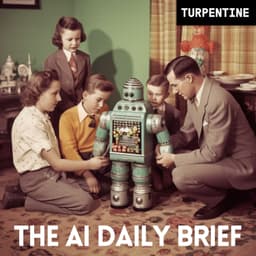
The Job Positions of the AI Future
The AI Daily Brief (Formerly The AI Breakdown): Artificial Intelligence News and Analysis by Nathaniel Whittemore · 26 min
Listen to episode →This episode explores how AI agents are changing work from direct execution to supervising, coordinating, and shaping the work that agents produce. It introduces a set of emerging organizational archetypes, especially the product-oriented roles of prototypeer, builder, sweeper, grower, and maintainer, which map to different stages of a product lifecycle. The episode also argues that the most valuable new roles may be externally facing ones such as editor, scout, evangelist, orchestrator, conductor, and risk steward, which help organizations decide what to build and how to govern it. A central thesis is that AI will make it cheaper and faster to turn ideas into first drafts, causing more people in every function to become a kind of internal maker. Overall, the conversation frames AI less as a job eliminator and more as a force that reshapes organizational design, speed, and decision-making.
Key Takeaways
- 01
AI shifts many jobs from doing the work to managing agents that do the work.
This reframes AI as an organizational transformation rather than only a labor-saving tool. Instead of replacing all workers outright, agentic AI changes the human role toward oversight, coordination, quality control, and higher-level judgment. That matters because it affects how teams are structured, what skills are rewarded, and how productivity gains are realized.
- 02
The prototypeer role becomes more valuable as tools like Claude Code and Codex make early versions cheap and fast to create.
When it takes minutes or hours instead of days or weeks to turn an idea into a working draft, the bottleneck moves from creation to evaluation. Technologies such as Claude Code and Codex lower the cost of experimentation, which encourages more ideas to be tested and discarded quickly. This makes rapid prototyping a strategic capability, not just a technical one.
- 03
The product lifecycle can be broken into distinct archetypes: prototypeer, builder, sweeper, grower, and maintainer.
Each role represents a different stage of value creation, from generating ideas to shipping production-grade systems to improving, simplifying, and sustaining them over time. The distinction helps organizations assign work more intentionally and recognize that different phases require different strengths. It also highlights that not everyone needs to be optimized for the same kind of work.
- 04
The most important missing roles may be externally facing functions like editor, scout, evangelist, orchestrator, conductor, and risk steward.
These roles help organizations decide what is worth building, connect ideas across boundaries, and ensure that AI-driven work stays aligned with business goals and constraints. The emphasis on risk steward is especially important because faster iteration can increase exposure to compliance, security, and reputational issues. In AI-native organizations, governance and direction become as important as raw output.
- 05
Every function is likely to grow its own 'maker' who can build small tools and prototype new workflows internally.
The episode suggests that AI will decentralize creation, allowing sales, marketing, operations, finance, and other teams to build their own lightweight automations and internal tools. This reduces dependence on centralized engineering for every small workflow change and speeds up experimentation across the organization. The concept reflects a broader move toward AI-enabled citizen building and workflow innovation.
- 06
Risk management should not be seen only as a bottleneck; it can also preserve momentum by making AI adoption safer and more scalable.
There is a tension between speed and control, but the episode implies that effective risk stewardship can enable faster progress rather than simply blocking it. In practice, this involves guardrails, review processes, and oversight for AI systems that touch customers, data, or regulated workflows. This is crucial for enterprises trying to adopt agentic AI without creating unacceptable operational risk.

Why NVIDIA Is Giving Away AI Models | Bryan Catanzaro
The MAD Podcast with Matt Turck by Matt Turck · 82 min
Listen to episode →This episode explores why NVIDIA, despite being a chip company, invests heavily in building and releasing its own AI models like Nemotron. Bryan Catanzaro explains the strategic logic: NVIDIA uses models to better understand the future of AI systems while also strengthening the ecosystem that runs on its hardware. The conversation goes deep into technical choices behind Nemotron 3 Ultra, including NVFP4 four-bit pretraining, a hybrid Mamba/Transformer architecture, mixture-of-experts, multi-token prediction, and advanced post-training methods. It also covers how these techniques improve efficiency, long-context reasoning, and agentic workflows for tasks like coding and document analysis. Beyond the models themselves, the episode examines NVIDIA’s research organization, compute allocation process, and broader views on open vs. closed AI and the role of openness in safety.
Key Takeaways
- 01
NVIDIA builds and releases AI models for both strategic insight and ecosystem support.
Bryan Catanzaro frames Nemotron as serving two purposes: helping NVIDIA understand how future AI systems should be designed and supporting the broader developer and customer ecosystem built around NVIDIA GPUs. This shows that model development is not separate from the hardware business; it is part of NVIDIA’s feedback loop for improving chips, software, and platform strategy. The approach ties together AI models, GPUs, and the company’s long-term competitive positioning.
- 02
Efficiency is becoming central to progress as AI training hits compute and power limits.
The episode argues that if AI continues to run at the edge of available compute, then gains in intelligence will increasingly come from doing more with less. Techniques like NVFP4 four-bit pretraining reduce memory use, bandwidth pressure, and energy costs, making large-scale training more practical. This is especially important for companies like NVIDIA that sit at the intersection of AI research and hardware constraints.
- 03
Nemotron combines multiple architectural ideas to improve both quality and efficiency.
Nemotron 3 uses a hybrid state-space plus Transformer design, mixture-of-experts, and multi-token prediction to improve performance. The hybrid architecture aims to capture global sequence structure efficiently while retaining the precision of attention, while MoE and multi-token prediction help scale capability and speed. These choices reflect a broader trend in frontier AI: systems are increasingly assembled from complementary techniques rather than relying on one dominant architecture.
- 04
Long context windows and multi-token prediction are practical enablers for agentic AI.
The episode emphasizes that models need to reason over codebases, documents, and personal or enterprise memory in order to be useful agents. Long-context capabilities help models maintain coherence over large inputs, while multi-token prediction can accelerate generation without sacrificing too much accuracy. Together, these features make AI more viable for real workflows where speed and sustained context both matter.
- 05
Post-training is shifting toward combining specialized signals from multiple sources.
Bryan describes post-training as an integration problem: models increasingly learn from multiple teachers, diverse datasets, and reinforcement learning signals to become broadly capable. This suggests that the final quality of a model depends not just on pretraining scale, but on careful orchestration of later-stage optimization. In practice, this is where a model becomes more aligned, useful, and robust for real-world use.
- 06
NVIDIA’s research culture is mission-driven and resource-constrained, not purely top-down.
The episode describes a collaborative structure where teams across GPU, enterprise software, and AI software contribute to projects like Nemotron. Compute allocation is reviewed on a two-week cycle, reflecting scarcity and the need to prioritize among many competing ideas. This creates a bootstrapping dynamic: researchers must show early promise before they can secure more resources, blending bottom-up exploration with strategic direction.

This episode explores how Bolt grew from a startup in tiny Estonia into a mobility platform operating across 50+ countries by using constraints as an advantage. Markus Villig discusses early strategic choices, including going directly to drivers instead of taxi intermediaries and learning to expand sequentially rather than trying to launch everywhere at once. The conversation also covers how Bolt adapted during COVID by rapidly scaling food delivery and then regaining ride-hailing share as markets reopened. A major theme is Bolt’s capital-efficient approach to competing with better-funded rivals, especially in Europe versus the U.S. The episode ends with a look at the future of mobility, where autonomous vehicles and human drivers will likely coexist in a hybrid network.
Key Takeaways
- 01
Bolt’s small home market forced the company to think globally from the start and build a model that could scale across many countries.
Operating from Estonia meant Bolt could not rely on a large domestic market to mature before expanding, so the team had to design systems and strategy for international growth early. This constraint became a competitive advantage, encouraging efficiency, adaptability, and a repeatable playbook for multi-country expansion.
- 02
Working directly with individual drivers proved more effective than partnering with taxi companies and other intermediaries.
Bolt found that taxi companies often acted as gatekeepers and were less aligned with customer experience, which created friction in supply growth. By building direct relationships with drivers, Bolt improved control over marketplace quality, strengthened supply acquisition, and created a better rider experience.
- 03
Expanding too broadly too early nearly bankrupted Bolt, teaching the team to grow sequentially and optimize one market at a time.
Bolt initially tried to scale in parallel across too many markets, which burned capital and made it difficult to identify which geographies had real traction. The shift to a one-market-at-a-time approach reflects a classic marketplace lesson: capital-efficient growth and deep operational learning often matter more than raw speed, especially when competing against larger rivals.
- 04
COVID became a turning point: Bolt lost most ride-hailing revenue but quickly scaled food delivery and used its network to recover in mobility.
The crisis showed the value of having an operational platform that could be repurposed quickly across categories. Bolt launched food delivery in about 60% of its ride-hailing markets and expanded to 16 countries in roughly four months, demonstrating how category adjacency can protect the business during shocks and create new growth paths.
- 05
Bolt sees the future of mobility as a hybrid system combining autonomous vehicles and human drivers rather than a full replacement.
Marcus argues that demand peaks and geographic coverage are too uneven for self-driving fleets alone to handle all use cases, especially outside dense urban cores. Technologies such as robotaxis and autonomy will likely serve high-density areas, while human drivers remain essential for flexibility, coverage, and balancing supply-demand volatility.
Questions answered in this issue
What is the main shift AI creates in jobs, according to this episode?
The main shift is from directly doing tasks to managing agents that perform those tasks. That changes the role of many workers from execution to oversight, coordination, and decision-making.
Why does the prototypeer role become more important in an AI-native workplace?
Because tools like Claude Code and Codex make it much easier to turn ideas into working first versions. That shortens the path from concept to conversation to something tangible, which helps teams evaluate ideas faster.
Why does NVIDIA build and release its own AI models instead of only selling chips?
Bryan says Nemotron has two jobs: first, it helps NVIDIA understand how to build the systems of the future; second, it supports the broader ecosystem that uses NVIDIA hardware. In his view, better models improve NVIDIA's ability to design better chips and software.
Why is four-bit pretraining such a big deal?
Four-bit arithmetic reduces memory use, bandwidth, and energy consumption, which matters if AI is going to keep running at the limits of compute and power. Bryan notes that doing this during pretraining is much harder than using four-bit checkpoints for inference, because the training process can diverge if the numerics are mishandled.
Why did Bolt switch from working with taxi companies to directly onboarding drivers?
Bolt found that taxi companies often acted as gatekeepers and did not care about customer experience. After seeing blocked drivers and hostile behavior, the company pivoted to direct driver relationships to improve supply and control the experience.
What did Bolt learn from its early attempt to expand into many countries at once?
The company learned that parallel expansion burns money and makes it hard to identify which markets are actually promising. Bolt shifted to a sequential, one-market-at-a-time approach and spent about 18 months refining the playbook.
Explore