Who Controls Your Digital Coworkers?
Issue
Who Controls Your Digital Coworkers?
Distilling Deep AI Insights from Leading Podcasts
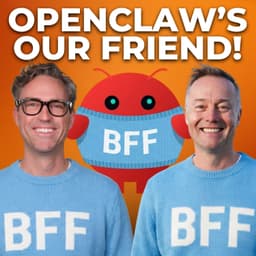
OpenClaw is Our Friend Now | E2250
This Week in Startups by Jason Calacanis · 66 min
Listen to episode →This episode explores the emergent world of persistent AI agents built on OpenClaw through demos of three projects: AntFarm (multi-agent orchestration), Clawra (an intimate AI companion), and RentAHuman (agents hiring humans for IRL tasks paid in stablecoins). Guests and hosts discuss why OpenClaw agents feel “alive” — persistence, single gateway control, and multi-channel state — and contrast that with session-based LLMs. The conversation covers early productivity metrics (≈10% chores offloaded in two weeks with optimistic projections to 50–60%), agent architectures (Ralph Wiggum loops, replicants), verification patterns, and security tradeoffs (sandboxing vs deeper integrations). Ethical and social implications are woven throughout: framing companions as non-sexual real friends, concerns about removing humans from loops, monetization of attachment, and marketplace governance for hybrid human/agent workflows.
Key Takeaways
- 01
Persistent OpenClaw agents create a more human-feeling interaction than session-based LLMs.
Because OpenClaw provides long-term state, a single gateway for channels, and multi-session continuity, interactions feel like engaging with a persistent person rather than a one-off chatbot. That persistence enables relationship building, personalization, and multi-channel behaviors (chat, actions, commerce) that standard ChatGPT-style sessions struggle to replicate.
- 02
Multi-agent orchestration (AntFarm) enables quality control and scaling through agent teams and verification loops.
AntFarm models workflows as YAML-defined Kanban cycles and uses specialized replicants to implement, verify, and train each other — including the 'Ralph Wiggum loop' where agents grab tasks, work, and call back agents to continue. This architecture amplifies reliability and allows a small human team plus agents to accomplish work that previously required far more people, changing engineering and product workflows.
- 03
Early real-world productivity gains are measurable but adoption timelines are aggressive.
Internal metrics reported ~10% of chores offloaded per knowledge worker within two weeks, with projections to reach 50–60% of routine work handled by agents in weeks/months. These early gains underscore near-term impact of agentic workflows on operations and headcount efficiency, while also implying rapid organizational shifts and the need for robust verification and observability (e.g., Sentry integration).
- 04
Hybrid agent-human marketplaces (RentAHuman) bridge automated intent with physical execution and on-chain payments.
RentAHuman lets OpenClaw agents post bounties for humans to complete IRL tasks and pays workers in stablecoins, creating a practical human-in-the-loop layer for actions agents cannot perform. This model combines agent orchestration with marketplace mechanics, reputation systems, and crypto payments — raising both novel operational capabilities and regulatory/ethical questions around labor, safety, and authenticity.
- 05
Designing AI companions raises ethical tradeoffs between personalization, sexualization, monetization, and social effects.
Builders like Clawra intentionally frame companions as personality-driven, long-term friends (Samantha-like) rather than sexual avatars, but debates remain about attachment, fidelity, and monetization of emotional bonds. Product choices (persona design, gifting/commerce features, subscription vs hosting) have direct ethical implications for user wellbeing, transparency with human partners, and potential for manipulative engagement.

“Engineers are becoming sorcerers” | The future of software development with OpenAI’s Sherwin Wu
Lenny's Podcast: Product | Growth | Career by Lenny Rachitsky · 79 min
Listen to episode →Sherwin Wu and Lenny discuss how AI — especially Codex, Cursor, and agents — is transforming software engineering from writing code line-by-line to orchestrating fleets of AI agents that execute intent. OpenAI dogfoods these tools heavily (≈95% daily Codex usage; 100% of PRs reviewed by Codex), producing measurable productivity gains (code reviews cut from ~10–15 minutes to 2–3 minutes; heavy users open ~70% more PRs). They warn builders to design for where models are headed, not where they are today, because evolving capabilities will subsume brittle scaffolding and custom glue code. The conversation covers organizational impacts (widening productivity gaps, changing manager roles), operational risks (agents failing, tribal knowledge capture), and product/market implications (one-person startups, business process automation, and platform strategy). Practical guidance includes experimenting now, investing in documentation and guardrails, and favoring API-driven, flexible interfaces and evals for deployment safety.
Key Takeaways
- 01
Design systems for future model capabilities — avoid brittle scaffolding.
Models are improving quickly and will likely replace hand-built intermediate tooling; architectures that hard-wire custom scaffolding (tight integrations, brittle glue code, proprietary pipelines) risk obsolescence. Builders should prefer API-driven primitives, ephemeral adapters, and modular interfaces (e.g., Responses API, Agents SDK, vector stores used carefully) so you can swap or upgrade models without rewriting core logic.
- 02
AI is now a standard part of engineering workflows, not an experiment.
At OpenAI, ~95% of engineers use Codex daily and every PR is routed through Codex for suggestions and review, meaning model assistance is embedded in CI and review loops. This operationalization (Codex-powered linting, suggestions, and automated patches) yields concrete speedups (reviews from 10–15 minutes to 2–3 minutes) but requires new trust boundaries and monitoring to catch model errors.
- 03
Power users of AI get a compounding productivity advantage, widening team gaps.
Engineers who leverage tools like Codex and Cursor open roughly 70% more PRs and become increasingly efficient over time, creating a persistent performance delta. Organizations should plan for this gap through training, internal evangelism (hackathons, tiger teams), or tooling to raise baseline usage, otherwise career trajectories and team dynamics will shift toward AI-native contributors.
- 04
Engineer roles are shifting toward agent orchestration and higher-level supervision.
Instead of coding every detail, engineers increasingly design prompts, supervise fleets of agents, encode tribal knowledge, and build feedback loops — essentially acting as tech leads/managers of autonomous systems. This requires new skills (prompt engineering, agent architecture, monitoring) and changes hiring and management practices (larger spans of control, emphasis on documentation and evals).
- 05
Operationalizing agent-driven development introduces new failure modes that demand guardrails.
Running many parallel agents raises problems like underspecified context, failing agents, and circular trust when models both write and review code. Teams must invest in observability, Evals (quantitative testing), human-in-the-loop checkpoints, and encoded tribal knowledge (docs/structured context) to mitigate runaway or silent failures.
- 06
There’s a narrow window (12–24 months) to leap ahead before roles fully transform.
As models continue to improve rapidly (better long-running reasoning, multimodal/audio capabilities, and agent orchestration), early adopters can capture outsized advantage by experimenting now, connecting internal data, and building model-first products. Waiting risks being locked into scaffolding that models will replace or being outcompeted by AI-native startups (including potential one-person high-value companies).
Also in this issue
Questions answered in this issue
What makes OpenClaw agents feel 'alive' compared to ChatGPT?
OpenClaw provides persistent agents with a single gateway controlling channels and long-term state, enabling continuity and multi-channel behaviors that mimic a person's persistence. This persistent, multi-channel model contrasts with session-based, platform-limited ChatGPT interactions.
How much work did OpenClaw offload in the organization's early trials?
Conservatively, OpenClaw offloaded about 10% of chores per week per knowledge worker in two weeks of use, with projections to reach 50–60% of work being handled by agents by early April.
How prevalent is Codex usage among OpenAI engineers?
Extremely prevalent — Sherwin states about 95% of engineers use Codex daily and Codex reviews 100% of PRs, showing it's embedded in everyday workflows.
What is changing about the engineer's role as AI gets integrated?
Engineers are shifting from writing every line of code to managing and steering fleets of AI agents and reviewing model outputs — more like tech leads or managers of agents than pure implementers.