Anthropic Claude development, scaling laws, agentic AI workflows, AI-assisted coding, startup AI innovation
Issue
Anthropic Claude development, scaling laws, agentic AI workflows, AI-assisted coding, startup AI innovation
Distilling Deep AI Insights from Leading Podcasts
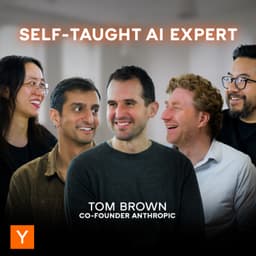
Anthropic Co-founder: Building Claude Code, Lessons From GPT-3 & LLM System Design
Lightcone Podcast by Y Combinator · 35 min
Listen to episode →The podcast episode features Tom Brown, co-founder of Anthropic, who shares his unique journey from modest academic beginnings to contributing significantly to AI breakthroughs, including the development of GPT-3 at OpenAI and Anthropic's Claude models. The discussion opens with Anthropic's early uncertainty and mission-driven focus, beginning amid the COVID-19 pandemic with limited resources while competing with established AI giants. Brown emphasizes adopting a survivalist 'wolf mindset' crucial for innovation in startup environments, contrasting with traditional task-driven roles. Reflecting on his early experience at YC startup Grouper, he illustrates how iterative product development and user-centered design laid the groundwork for later AI ventures. Transitioning into AI research involved intense self-study overcoming skepticism toward AI safety and research as a viable career path. A key technical insight arose from scaling laws, revealing that increasing compute predictably enhances AI model intelligence, guiding the strategic emphasis on infrastructure at OpenAI and Anthropic. Anthropic's culture of radical transparency through public Slack channels and mission alignment supported rapid growth and cohesive development. The group's evolution included a cautious product launch approach, focusing first on infrastructure before the market expanded post-ChatGPT, with Claude eventually evolving into specialized models notably proficient in coding tasks. Brown notes an industry-wide discrepancy between benchmark results and real-world developer preferences, hinting at an 'X factor' in user experience and AI model capabilities. He also describes how internal tool development, like Claude Code—treating AI as a direct user—boosted productivity and market success. The episode closes with reflections on unprecedented AI infrastructure scale, hardware-software trade-offs, and career advice encouraging intrinsic motivation over traditional credentials, highlighting the dynamic and uncertain landscape of AI innovation.
Key Takeaways
- 01
Anthropic's foundation was characterized by uncertainty and a mission-driven resolve despite facing strong competitors like OpenAI, starting with seven co-founders during the COVID pandemic without a clear product vision.
This demonstrates the significance of having a compelling long-term mission in emerging fields like AI when immediate product-market fit is unclear. Anthropic’s commitment to what is described as 'humanity's largest infrastructure build-out ever' reflects a strategic focus on foundational capabilities over quick wins. Persisting through ambiguity in startup life, especially in capital-intensive environments dominated by larger incumbents, requires sustained vision and resilience. This mindset is particularly relevant for businesses aiming to enter AI infrastructure or foundational model development, suggesting that early-stage uncertainty is common and manageable with strong mission alignment and patience.
- 02
Tom Brown’s path into AI was highly non-traditional, combining startup experience with rigorous self-study to overcome his modest academic record, exemplifying how practical entrepreneurship and self-education can substitute for formal credentials in AI careers.
Brown’s journey challenges the prevailing assumption that only academically elite individuals can break into transformative AI research. His 'wolf mentality'—a survivalist, proactive approach—emerged from early YC startup roles and was critical to his success. His commitment to self-study through online courses, Kaggle competitions, and hands-on experimentation shows the value of accessible education and intrinsic motivation in AI talent development. This insight encourages aspiring engineers to leverage diverse experiences and persistence to bridge skill gaps, a theme resonant in today’s AI industry where talent pipelines are increasingly varied and non-linear.
- 03
The discovery and application of scaling laws underpin much of the progress in large language models, revealing a predictable and nearly linear increase in intelligence with increased compute, which shaped strategic decisions at OpenAI and Anthropic.
Scaling laws provide a mathematical and empirical framework that justifies massive investments in compute resources, such as the shift from TPUs to GPUs to achieve more efficient large-scale training exemplified by GPT-3. This principle has guided AI labs in prioritizing infrastructure scalability and algorithmic efficiency, enabling models like Claude and GPT-3 to reach unprecedented capabilities. However, it also raises concerns about resource intensity, cost, and environmental impact, fueling debates on sustainable AI research. For businesses and developers, understanding and leveraging scaling laws is critical to plan product roadmaps, infrastructure investments, and R&D efforts effectively.
- 04
Anthropic’s organizational culture of radical transparency, using fully public Slack channels and mission-centric alignment, fostered effective collaboration and cohesion during rapid scaling.
Such openness promotes trust and minimizes intra-organizational political friction, which can hinder innovation, especially in fast-moving AI environments. Public communication channels ensure knowledge sharing across roles and functions, supporting agile decision-making and accountability. This kind of culture is particularly important in AI organizations balancing fast growth with the complexities of safety and ethical considerations. Other startups and AI enterprises can draw from this approach to maintain strong team alignment and operational clarity under pressure.
- 05
Anthropic’s initial product development prioritized robust infrastructure and compute acquisition over immediate market releases, with the launch of early tools like the Claude Slack bot preceding widespread commercial adoption catalyzed by ChatGPT.
This highlights a common but underappreciated startup challenge in AI: bridging the gap between research and viable products often requires lengthy infrastructure maturation and experimentation. Anthropic’s cautious timing underscored a respect for safety and market readiness, avoiding premature release of transformative AI tools. The pivot in market dynamics following ChatGPT’s success enabled broader API relaunches and positioning Claude as a competitive alternative. This pattern underscores that patience and incremental validation remain key in AI product cycle management, especially for responsible innovation.
- 06
Focusing on coding capabilities within large language models became a deliberate strategic niche for Anthropic, improving product-market fit and enabling emergent agentic coding functionalities that resonated strongly with developers.
By doubling down on software engineering tasks, Anthropic tapped into a growing demand for AI-assisted coding tools, exemplified by models like Claude 3.5 Sonnet. This specialization added competitive differentiation in a crowded AI assistant space, attracting startups and developer communities. The agentic coding features allowing autonomous task execution expanded possibilities for productivity enhancement and novel applications. This direction aligns closely with industry trends where coding assistance and automation represent high-value, high-impact verticals within AI, likely to shape future developer tools and enterprise adoption.
- 07
Real-world developer preference for Anthropic’s coding models significantly outstrips benchmark predictions, suggesting that conventional quantitative benchmarks fail to capture key qualitative features valued by users.
This points to an important gap in AI evaluation: benchmarks often measure narrow metrics that may not reflect crucial aspects like usability, reliability, interpretability, and interaction quality. The notion of an unexplained 'X factor' calls for broader and more sophisticated assessment frameworks that incorporate user satisfaction and contextual effectiveness. For industry players, recognizing this mismatch is essential for product strategy, as emphasizing user experience can yield competitive advantages beyond technical scores. It also invites the AI community to rethink evaluation priorities to better align development with end-user needs.
- 08
Anthropic’s internal development of Claude Code, an AI tool treating the AI itself as a primary user, demonstrates a user-centric and iterative approach that significantly contributed to the product’s external market success.
By dogfooding AI tools and optimizing for AI-as-user interaction, Anthropic enhanced the model’s capabilities in complex tasks such as decompiling binaries into modifiable source code, a non-trivial feat requiring deep understanding. This approach nurtures higher empathy for AI operational contexts, yielding more effective and usable tools. For developers and startups, it suggests that designing AI products with internal feedback loops and close attention to AI usability can unlock substantial productivity and differentiation. This methodology also reflects a broader innovation trend where AI tools are built and refined through intensive internal engagement before reaching wider audiences.
- 09
The podcast highlights the unprecedented scale and rapid growth of AI infrastructure investment, described as the largest infrastructure build-out in history, surpassing historic projects like Apollo and Manhattan.
This contextualizes the immense capital, energy, and resource concentration fueling the current AI boom, with spending on AGI compute increasing roughly threefold annually. Such scale intensifies engineering challenges around hardware heterogeneity, software stacks, and operational complexity as labs deploy GPUs, TPUs, and other specialized accelerators. It signals critical implications for supply chains, sustainability, and global technological leadership. Companies and policymakers must grapple with these expansions’ environmental and geopolitical impacts while fostering innovation. For AI labs and startups, managing infrastructure scale effectively is a key determinant of competitiveness and technological advancement.
- 10
Career advice from Tom Brown encourages young engineers to value intrinsic motivation, practical skills, and risk-taking over traditional markers like formal degrees or employment at major tech firms, reflecting shifts in AI talent pathways.
Given the fast-evolving and interdisciplinary nature of AI research and development, success increasingly depends on adaptability, continuous self-learning, and entrepreneurial initiative rather than conventional credentials alone. Brown’s own experience underlines that which is valued in AI circles includes practical problem-solving and resilience in ambiguous environments. This advice challenges established norms in computer science education and hiring, potentially broadening access to AI careers. Educational institutions and businesses may need to adapt, creating alternative channels and support structures to cultivate diverse talent suited for the unique demands of AI innovation.

How Agentic AI is Transforming The Startup Landscape with Andrew Ng
No Priors: Artificial Intelligence | Technology | Startups by Conviction · 42 min
Listen to episode →In this episode of Conviction, Andrew Ng, a pioneering figure in artificial intelligence, discusses how agentic AI is revolutionizing the startup landscape. Ng defines agentic AI as a spectrum of autonomous AI workflows capable of multi-step planning and execution, moving beyond strict binary agent definitions. He highlights multiple vectors for AI capability growth, including agentic AI, multimodal models, and diffusion models, underscoring that future progress will not rely solely on scaling models or accumulating data. The shortage of skilled talent to systematically engineer, test, and iterate agentic AI workflows remains a major obstacle to wider adoption. Ng illustrates the tangible economic value of agentic AI, particularly through AI-assisted coding agents like cloud code, which accelerate software development and improve productivity. He critiques the term "vibe coding," emphasizing that AI-assisted coding is a disciplined and rigorous engineering practice requiring active human oversight. AI is transforming startups by enabling rapid product iteration and smaller, more agile teams, shifting bottlenecks toward product management rather than engineering speed. The profile of successful founders is evolving to prioritize deep technical fluency and up-to-date AI knowledge, echoing the technical leadership models of early Silicon Valley pioneers. Ng stresses the critical role of empathy in product management to deeply understand user needs, complementing technical skills. Additionally, he advocates for coding literacy across all organizational roles, enhancing cross-functional efficiency and AI tool utilization. The episode also explores AI's impact on traditional industries like legal and healthcare, the shifting dynamics in talent hiring prioritizing AI fluency, and the importance of a founder mindset embracing rapid iteration and learning by doing. Throughout, Ng emphasizes the rapid pace of AI evolution, requiring startups, leaders, and teams to continuously adapt or risk obsolescence.
Key Takeaways
- 01
Andrew Ng views AI capability growth as multifaceted, emphasizing agentic AI workflows, multimodal models, and diffusion models as key drivers beyond just increasing model scale or data.
Ng challenges the common narrative that AI progress hinges mainly on scaling model sizes and data volume, instead highlighting diverse technological approaches. Agentic AI, where AI systems autonomously plan and execute tasks, represents a shift to more autonomous, practical applications. Multimodal models that handle different data types (e.g., text and images) allow more complex, context-rich AI behaviors. Diffusion models, originally used in image generation, show promise for text generation, indicating cross-pollination in AI methods. This diversified view signals to businesses and developers that relying on a single strategy for AI innovation may be insufficient, encouraging investment in varied AI technologies that can complement each other. It anticipates an AI landscape where capability improvements arise from synergy among multiple paradigms, better aligning products with complex real-world demands.
- 02
The term 'agentic AI' was coined by Ng to represent AI systems along a spectrum of autonomy, focusing on pragmatic development of autonomous workflows rather than rigid agent definitions.
Ng introduced 'agentic AI' to cut through semantic debates on what exactly constitutes an autonomous agent. By framing agency as a spectrum—from low autonomy to high—he encourages engineering teams to pursue incremental improvements in AI autonomy without waiting for fully autonomous agents. This approach accelerates research and deployment by broadening the definition to include various degrees of agentic behavior, fostering practical innovation. While initially met with skepticism and marketing hype, the concept grounds a strategic mindset shift in AI development prioritizing effective autonomous workflows over theoretical purity. For industry, this lowers barriers to adoption by validating partial autonomy as progress, encouraging products that leverage AI agents' varying capacities.
- 03
A critical barrier to deploying true agentic AI is the scarcity of disciplined engineering talent skilled in systematic error analysis, evaluation, and iterative workflow refinement.
Ng highlights that while compute power and data are improving, human expertise to rigorously drive engineering cycles remains limited. Successful agentic AI requires detailed error analysis and evaluation processes executed by adept engineers who apply mental models and data-driven troubleshooting. Teams lacking this expertise tend to rely on unguided trial and error, slowing development and limiting product reliability. The talent bottleneck underscores the importance of hiring and training for rigorous engineering discipline alongside AI model expertise. It also presents an opportunity to develop better tooling that automates parts of evaluation and iteration, ultimately scaling agentic AI development. For startups and investors, prioritizing teams with strong engineering rigor is vital for realizing complex AI applications.
- 04
AI-assisted coding agents are among the most economically impactful applications of agentic AI, drastically improving software development speed through autonomous multi-step coding workflows.
Ng emphasizes that AI systems capable of autonomously planning and executing code writing—what he terms coding agents—introduce significant productivity gains, allowing developers to build applications faster with fewer resources. Real-world examples like cloud code illustrate how such tools manage checklists and multi-step tasks, transforming developer workflows. This shift is especially beneficial for startups aiming for rapid iteration and lean operations, altering traditional team structures and timelines. The adoption of coding agents suggests that AI augmentation of programming tasks is not only feasible but immediately valuable, signaling a broader trend where AI tools become essential developer collaborators. Businesses investing in AI-assisted coding stand to gain measurable competitive advantages via accelerated innovation cycles.
- 05
Ng rejects the colloquial notion of 'vibe coding' in favor of viewing AI-assisted coding as a disciplined and intellectually rigorous process requiring human oversight.
The term 'vibe coding' implies a casual or intuition-driven acceptance of AI recommendations, which Ng argues is misleading and risks poor coding outcomes. He stresses that although AI can speed up coding, developers must critically evaluate suggestions within structured workflows. Framing it as 'AI-assisted coding' underscores the ongoing need for human judgment, testing, and iteration. This distinction is important to set realistic expectations among developers and teams integrating AI tools, promoting responsibility and rigorous engineering practices. It also addresses skepticism within the developer community wary of overhyped AI capabilities that neglect engineering discipline.
- 06
AI is reshaping startups by enabling dramatically faster product iteration cycles and allowing smaller teams to accomplish what previously required larger groups.
Ng notes that AI-powered tools compress core startup loops—building, user testing, feedback gathering, and iteration—from months to days or even hours in some cases. This speed enables single individuals or small teams to prototype and refine products at unprecedented rates, reducing time-to-market and resource needs. Consequently, startups can operate with lower overhead and more agility. However, this also shifts bottlenecks away from engineering speed toward product management, as deciding what to build becomes the limiting factor. This evolution affects hiring, emphasizing the critical role of rapid decision-makers and user research experts alongside lean, AI-enabled engineering teams.
- 07
The profile of successful startup founders is evolving to prioritize technical expertise and deep AI fluency alongside traditional business acumen.
Ng asserts that due to rapid AI advancements, founders relying solely on outdated business strategies risk falling behind. Technical fluency—understanding AI capabilities, limitations, and strategic implications—is now essential for navigating the startup landscape. This shift marks a return to the classic Silicon Valley archetype exemplified by pioneers like Gates, Jobs, and Wozniak, who combined technical mastery with visionary leadership. For investors and teams, this means valuing founders who grasp both product-market fit and the underlying technology. It also signals the need for founders to continually update their AI knowledge to maintain relevance and competitive advantage in emerging markets.
- 08
Empathy and the ability to synthesize diverse user data remain crucial for effective product management in AI startups, complementing technical skills.
Ng emphasizes that technical background alone does not ensure product management success; strong human empathy is necessary to understand user needs deeply. Effective product managers integrate signals from surveys, behavioral data, market research, and direct feedback to form nuanced mental models of target customers. This user-centric approach enables rapid, aligned decision-making in complex and fast-evolving AI product environments. Neglecting empathy risks building products misaligned with market demands, slowing adoption. Organizations should invest in cultivating empathy alongside technical skills, possibly fostering hybrid roles and interdisciplinary teams to maximize product success.
- 09
Learning to code is becoming an essential skill for all organizational roles, not just engineers, to fully leverage AI tools and improve job performance.
Ng advocates for democratizing coding skills across functions such as finance, legal, and operations, enabling personnel to interact more effectively with AI-driven automation. As AI permeates workflows, coding literacy empowers employees to automate tasks, customize solutions, and reduce reliance on specialized engineering teams. This enhances organizational agility, speeds innovation, and improves operational efficiency. Ignoring this trend risks creating bottlenecks and reducing overall productivity. Companies are thus incentivized to invest in technical training programs or tools that make coding accessible to a broader workforce.
- 10
Proficiency in AI-assisted tools is becoming a key differentiator in engineering talent, sometimes outweighing years of traditional experience.
Ng shares a hiring example where a fresh graduate adept at AI tools was preferred over a seasoned engineer lacking AI fluency, illustrating a paradigm shift in evaluating engineering capabilities. This change highlights how productivity hinges increasingly on the ability to leverage AI augmentation rather than solely on experience. It urges organizations to integrate AI training into professional development and adjust talent acquisition strategies to prioritize AI competence. The trend reflects broader workforce transformations as AI reshapes job requirements, career paths, and organizational effectiveness. Engineers and other professionals must embrace continuous learning of AI tools to remain competitive.
Questions answered in this issue
What motivated the founders of Anthropic to pursue AI development despite having no clear product vision initially?
The founders were driven by a long-term mission rather than immediate product clarity. They recognized that humanity is on track to build the largest infrastructure ever related to AI and wanted to contribute meaningfully to that transformational process. The early uncertainty did not deter them because the potential impact of AI technology mandates committed infrastructure and ethical development. This mission-driven approach is crucial for bold AI initiatives where short-term products may not reflect the long-term vision.
How did Tom Brown’s background and early career choices shape his approach to AI research?
Tom Brown’s path was unconventional: starting in YC startups and struggling with programming, he nonetheless embraced the 'wolf mindset' of resourcefulness. His experience in multiple startups, including Grouper, taught him about scaling and team building, while self-study in linear algebra and machine learning prepared him technically. This journey illustrates combining entrepreneurial resilience and technical self-discipline to succeed in AI, reflecting a trend where practical experience complements formal education.
What did Andrew Ng mean by 'agentic AI' and why did he coin this term?
Andrew Ng coined the term 'agentic AI' to encompass AI systems functioning as agents with varying degrees of autonomy rather than focusing on a binary definition of what constitutes an agent. He observed extensive debate in the AI community about whether specific systems qualified as agents and found it more productive to consider a spectrum of agency. This reframing enables engineers and researchers to focus on building practical autonomous AI workflows regardless of strict classifications, accelerating progress. Despite initial annoyance from his team and marketers using the term for hype, the term stuck and became salient in the AI discourse.
According to Andrew Ng, what are the main current obstacles in implementing true agentic AI?
Ng identifies the primary obstacle as the shortage of talent capable of systematically driving disciplined engineering processes, including error analysis, evaluation (evals), and iterative improvement of agentic workflows. While technological components such as inference compute and memory are improving, these human skills for managing complex agentic systems are in short supply. Many teams lack a methodical approach and rely on random trial and error, slowing down progress. Therefore, building scalable agentic AI depends heavily on recruiting engineering talent with strong product instincts and robust evaluation capabilities.