AI model advancements, Marketing Strategies for 2025 Growth with the CMOs of Snowflake, LinkedIn, and Carta
Issue
AI model advancements, Marketing Strategies for 2025 Growth with the CMOs of Snowflake, LinkedIn, and Carta
Distilling Deep AI Insights from Leading Podcasts

The 10 Trillion Parameter AI Model With 300 IQ
Lightcone Podcast by Y Combinator · 33 min
Listen to episode →The podcast episode titled 'The 10 Trillion Parameter AI Model With 300 IQ' discusses the significant advancements in AI technology, particularly focusing on the OpenAI O1 model. The hosts explore the implications of these technological breakthroughs on startups, competition, and market dynamics. They express concerns that if the O1 model proves overly dominant, it may inhibit innovation, leaving little space for smaller startups to thrive. The conversation underscores the heavy capital required to develop such large models, highlighting the economic barriers new entrants face in AI. In addition to predicting a future dominated by powerful AI tools, the hosts discuss the efficacy of model scaling versus optimization, emphasizing the importance of practical applications through techniques like model distillation. The podcast also touches on the integration trends in development environments and the emergence of tools that streamline workflow, allowing developers to focus more on user experience and creative tasks. With an increasing interest among early adopters of O1, the episode hints at a transformative era for software development driven by AI innovations.
Key Takeaways
- 01
The OpenAI O1 model could significantly disrupt the startup ecosystem.
The O1 model's unprecedented capabilities may lead to a monopolization of market value by OpenAI, presenting challenges for new startups to carve out niches. With its exceptional ability to handle vast amounts of data, the model could outperform smaller competitors, posing risks of stagnation in innovation. This notion resonates with the current trends of consolidation within the tech industry where larger players dominate, causing lighter resource startups to struggle.
- 02
The landscape of AI investment is becoming capital-intensive.
The episode highlights how significant financial backing is now a prerequisite for developing advanced AI models like O1, as demonstrated by OpenAI's historic $6.6 billion funding round. This trend suggests a shift in the startup dynamic where only well-funded companies can afford to compete in building robust AI systems. Consequently, such conditions may deter new entrants from innovating within the AI sector due to the fear of inadequate resources to sustain development.
- 03
Distillation techniques are vital for practical AI applications.
Distillation allows for the generation of smaller, more efficient models that retain the intellectual capabilities of larger ones, making advanced AI accessible to a wider audience. This method is crucial for startups aiming to leverage powerful AI without incurring high computational costs associated with operating full-scale models. The podcast emphasizes that companies leveraging distillation effectively may find growth opportunities by creating specialized solutions utilizing distilled models.
- 04
Larger AI models may not guarantee superior performance.
As the podcast notes, simply increasing the parameter count in AI models doesn't ensure an improvement in efficiency or output efficacy. The conversation suggests that it may be more beneficial to focus on optimizing existing models, emphasizing utility over size. This point reflects a broader dialogue in the AI community regarding the sustainability of model scaling versus optimization, foreshadowing a potential pivot in research priorities.
- 05
The merger of coding tools and frameworks is evolving.
The discussion identifies a trend where integration among development tools like O1 and showcases improved workflows. This evolution leads to faster development cycles, reduced errors, and heightened productivity among developers, transforming how applications are built. Such seamless integrations may redefine competitive standards, propelling forward businesses capable of delivering better user experiences.
- 06
Early adopters are rapidly exploring innovative applications of the O1 model.
Rapid adoption among developers indicates an awakening to the productivity advantages provided by O1, prompting them to utilize its capabilities in real-world applications. This initial phase of engagement, characterized by hackathons and early access projects, reflects the industry’s eagerness to harness advanced AI technologies for innovative solutions. The enthusiasm from early users showcases a growing interest in the transformative potential of AI in software development.
- 07
Voice technology is emerging as a major trend in AI applications.
The increasing utilization of voice applications marks a shift towards conversational UI, highlighting opportunities for enhanced customer engagement and operational efficiency. The episode notes that companies leveraging AI-driven conversational interfaces are witnessing notable traction, indicating an evolving market that startups can capitalize on. This trend correlates with broader consumer preferences, increasingly driven by interactive technology that prioritizes ease of use.
- 08
The emergence of new tools like Cursor demonstrates market dysregulation in AI.
New players in the coding assistant space like Cursor are gaining significant traction, showcasing the importance of user experience in driving success amidst advanced AI offerings. The podcast highlights Cursor's advantages in terms of functionality over incumbents like GitHub Copilot, suggesting that user experience is becoming increasingly crucial. This shift emphasizes the need for established firms to innovate continuously or risk being outperformed by newcomers focused on usability.
- 09
The balance between technical capability and user experience will dictate the winners in AI development.
The episode concludes with a strong assertion that the future of competitive advantage in AI development will hinge on who can deliver superior user experiences rather than just technological prowess. As tools grow more advanced, those that succeed will be those that align technical functionality with ease of use, creating more engaging experiences for developers. This finding aligns well with current market dynamics, indicating that great user experience will be a key differentiator in capturing market share.
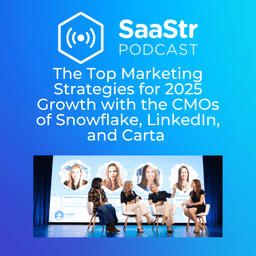
SaaStr 771: The Top Marketing Strategies for 2025 Growth with the CMOs of Snowflake, LinkedIn, and Carta
The Official SaaStr Podcast: SaaS | Founders | Investors by SaaStr · 29 min
Listen to episode →In the SaaStr 771 episode, a panel of CMOs from Snowflake, LinkedIn, and Carta delve into the pivotal marketing strategies necessary for growth in 2025. They discuss the critical importance of seamless customer experiences, especially during renewal phases, arguing that positive interactions are vital to customer retention. The conversation underscores the necessity of investing in customer experience and breaking communication silos among support, marketing, and customer success teams. Additionally, the topic of category creation is highlighted as a significant strategy, particularly for early-stage companies attempting to differentiate themselves in a competitive marketplace. Snowflake's evolution is presented as a case study of effective positioning and adaptation in the cloud data space. The panel also explores the role of generative AI in enhancing sales productivity and community-building initiatives in marketing. Emerging trends include a shift from performance-based marketing tactics to a focus on comprehensive, scalable strategies that prioritize long-term engagement over quick wins. Overall, the episode addresses the challenges CMOs face in a rapidly changing landscape, sharing insights on aligning organizational goals and investing in workforce development to support growth.
Key Takeaways
- 01
Seamless customer experience is essential for retention and growth.
In the current competitive landscape, delivering a seamless customer experience is crucial, especially during renewal discussions. By ensuring consistency and value across all customer touchpoints, companies can positively influence clients' decisions to renew engagements. Enhanced customer experiences often translate into higher satisfaction and loyalty, which are fundamental for ongoing revenue growth.
- 02
Integrating customer support and marketing eliminates silos.
Effective collaboration between marketing, customer support, and customer success teams creates a holistic approach that resonates better with customers' needs. This integration enables personalized interactions that enhance customer satisfaction and loyalty. By merging these departments, companies can streamline processes and eliminate the inefficiencies typically present in siloed structures.
- 03
Category creation is vital for startups in crowded markets.
For early-stage companies, defining and occupying a unique category can differentiate them in a saturated market. The importance of this strategy lies in creating clearer value propositions that resonate with target customers. Notable discussions in the episode emphasize how companies can leverage established categories to gain market credibility and attract necessary budgets.
- 04
Snowflake's strategic evolution highlights effective repositioning.
As Snowflake transitioned from being a data warehouse to a cloud-first data solution, it showcased the necessity of adapting marketing and positioning strategies in line with technological advancements. This realignment demonstrates how businesses must pivot and communicate their changing value propositions to capture market interest effectively.
- 05
Generative AI is a transformative tool for enhancing sales productivity.
The episode reveals that leveraging generative AI significantly improves efficiency in sales processes. By automating tasks and streamlining communication, sales teams can dramatically increase their meeting rates and overall productivity, thus allowing for improved engagement with potential customers. This shift is particularly timely as businesses confront growing pressures to optimize performance.
- 06
Community engagement is becoming a central marketing strategy.
Marketers are prioritizing community-building efforts over traditional advertising methods, recognizing that authentic relationships drive brand loyalty. As in-person events resurge, companies are inclined to focus resources on community interactions, which can forge deeper connections and enhance customer retention.
- 07
Full funnel marketing strategies are crucial for sustained growth.
By adopting a comprehensive marketing approach that encompasses all stages of the customer journey, rather than just the bottom of the funnel, companies can foster long-term engagement and brand loyalty. This holistic perspective ensures that marketing initiatives build awareness and interest early in the buying process, ultimately contributing to higher customer retention and lifetime value.
- 08
Scaling efficient marketing initiatives is essential.
The panelists stress the importance of focusing on repeatable and scalable marketing efforts to maximize impact, particularly in the face of resource constraints. By identifying successful initiatives and adjusting them for scalability, marketing teams can enhance their operational efficiency and overall effectiveness.
- 09
Investment in workforce development ensures adaptability.
To navigate shifting technologies and market demands, companies must prioritize their teams' learning and development. By fostering an environment of continuous growth, organizations can maintain agility and innovation, allowing them to effectively integrate new tools and methodologies into their marketing strategies.
Also in this issue
Questions answered in this issue
What are some potential implications of the O1 model on competition in the AI space?
The O1 model's capabilities may lead to a significantly competitive landscape where OpenAI could potentially dominate, influencing price and innovation dynamics. If it captures too much market capability, smaller startups may struggle to find their foothold. Yet, this landscape could also create pathways for specialized innovations using the O1 model as a backbone, thereby fostering niche markets.
How does model size factor into the future of AI development?
Model size is heavily tied to the ambition for higher performance benchmarks. However, it is becoming clear that growing size does not guarantee better performance, leading to growing discourse on the necessity of artificial scaling. This realization could pivot research focus toward enhancing existing models for utility instead of just making them bigger.
How can companies enhance their marketing outreach amid declining conversion rates?
Companies can investigate new marketing channels, adopt data-driven analytics, and improve audience segmentation to better tailor their outreach messages. Many CMOs emphasize the need to adapt messaging continuously based on changing consumer behaviors and preferences, suggesting that leveraging customer insights will allow for more impactful engagement.
How can early-stage companies effectively create their own category in a crowded market?
Creating a category involves identifying a unique value proposition that resonates with potential customers and clearly articulating it. Companies should analyze market trends and competitor positioning to find gaps they can fill. Additionally, engaging customer feedback during this process can provide valuable insight that shapes the category identity.