TL;DL AI Digest 2026-10-03
Issue
TL;DL AI Digest 2026-10-03
Distilling Deep AI Insights from Leading Podcasts
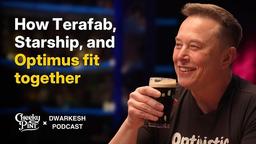
Elon Musk — "In 36 months, the cheapest place to put AI will be space”
Dwarkesh Podcast by Dwarkesh Patel · 169 min
Listen to episode →The episode is a wide-ranging deep dive with Elon Musk on the economics and engineering of putting large-scale AI compute in space, the bottlenecks to terrestrial compute scaling, and how robotics and digital human emulation multiply human productivity. Musk argues orbital solar + orbital datacenters can deliver multiplex more usable power than ground-based solar and predicts space will be the cheapest place to run large AI within ~36 months, given sufficient launch cadence and manufacturing. The conversation also covers practical engineering choices (debug hardware on Earth first), long-term scaling beyond terawatts (lunar/extra-Earth resources), and the roadmap from digital emulators to humanoid robots (Optimus) enabling recursive manufacturing. The episode touches on alignment and governance—how to instill human-aligned values as silicon intelligence scales—and geopolitical/economic implications for national competitiveness and industrial supply chains.
Key Takeaways
- 01
Orbital solar and data centers can be dramatically more power-efficient than terrestrial options.
Space solar yields roughly 5x more per-area usable power (and effectively up to ~10x when you remove the need for night-time storage) because it avoids atmosphere, weather, and day/night cycles. This changes the cost curve for massively concentrated compute: once launch and assembly scale, orbital power + compute could undercut ground-based hyperscalers constrained by grid, permitting, and generation bottlenecks.
- 02
Near-term compute scaling is limited first by power and permitting on Earth, and later by chip and memory supply once space power is unlocked.
On Earth, building generation capacity and securing grid interconnects and permits are slow, costly constraints before you hit chip limits. If orbital power becomes economical, the bottleneck shifts to semiconductor and memory manufacturing capacity—meaning fabs, DRAM supply, and packaging will determine how far compute can scale.
- 03
Practical deployment strategy: validate and burn-in hardware on Earth before migrating to space.
To avoid early 'infant mortality' failures that would be costly to service in orbit, GPUs and other components should be debugged and run extensively on the ground first. This reduces on-orbit servicing cadence and makes orbital infrastructure operationally feasible with current reliability profiles.
- 04
Digital human emulation is the near-term multiplier before physical robots become ubiquitous.
A faithful digital coworker that replicates desktop behavior and judgment unlocks enormous addressable markets (customer service, design, software tasks) because it multiplies human labor purely in software. This is a lower-hardware-barrier route to monetizable AI impact, and will likely precede and accelerate demand for physical humanoids.
- 05
Humanoid robots (Optimus) enable recursive manufacturing and industrial competitiveness, but require first-principles hardware development.
Hands, actuators, sensors, and custom motors are exceptionally hard hardware problems with no existing catalog supply chain—solving them is necessary for robots to perform useful manipulation and to build more robots. When combined with exponential improvements in compute and AI, physical robots could restore manufacturing competitiveness (e.g., relative to lower-cost human labor) and enable high-volume domestic production.

Dylan Patel: NVIDIA's New Moat & Why China is "Semiconductor Pilled”
The MAD Podcast with Matt Turck by Matt Turck · 76 min
Listen to episode →The episode is a deep dive into the evolving AI chip landscape, arguing that NVIDIA is moving from a one-GPU-fits-all mindset toward a multi-chip portfolio that embraces specialized inference hardware. Dylan Patel emphasizes that software (inference engines, KV-cache management) and developer UX are as important as raw silicon for delivering low-cost, fast tokens. The conversation explores geopolitical and industrial dynamics: China’s provincial push toward vertical semiconductor capabilities, limits to full onshoring in the U.S., and the strategic stakes of AI leadership. A central macro framing is whether current AI CapEx is a bubble or a necessary buildout — with continued model progress presented as the decisive variable. The hosts also challenge popular narratives about data centers’ resource impacts and discuss how startups can win in narrow, high-value domains despite NVIDIA’s dominance.
Key Takeaways
- 01
Hardware specialization can deliver order-of-magnitude gains for targeted workloads.
Specialized chips or architectural approaches (e.g., ultra-fast decode blocks, video-focused accelerators, long-context memory fabrics) can beat general-purpose GPUs on latency, throughput, or cost for particular domains. This creates opportunities for startups and for NVIDIA’s own portfolio strategy to place point solutions where they make economic sense, rather than relying solely on a universal GPU.
- 02
Software and developer UX are equally critical to inference economics as raw silicon performance.
Open-source inference engines (like VLLM), KV-cache managers, and efficient pre-fill and memory strategies determine how well hardware is utilized and whether multi-chip systems are practical. Improvements in software stack and orchestration can drastically reduce cost-per-token and make less-powerful or specialized hardware competitive for deployment.
- 03
NVIDIA is intentionally shifting to a portfolio approach to defend and extend its moats.
Rather than betting everything on one general GPU, NVIDIA is acquiring or licensing technologies (and partnering on software) to address specialized inference tasks and context handling, which helps it cover more workload niches and raise the bar for challengers. This strategy has competitive and potential antitrust implications, since vertical integration into model/runtime layers can limit startup pathways.
- 04
China is heavily committed to building a vertically integrated semiconductor ecosystem, but leading-edge gaps remain.
Provincial subsidies, domestic foundries for older nodes, and integrated supply-chain programs make China 'semiconductor pilled'—deeply focused on chip self-reliance—especially for non-leading-edge components. However, critical gaps persist in top-end lithography, advanced materials, and some tooling, so full parity at the bleeding edge is still challenging in the near term.
- 05
Whether current AI CapEx is a bubble hinges on continued model progress driving sustainable demand.
If models keep improving (efficiency, capability, new modalities), heavy infrastructure spending on datacenters, power, and specialized silicon is justified and the buildout will pay off; if model progress stalls, many recent investments risk poor returns and could look like overcapacity. This makes forecasting model trajectories the single most important variable for investors, builders, and policymakers.

Alexa+ is now available to everyone in the US
TechCrunch Daily Crunch by SpokenLayer · 7 min
Listen to episode →The episode covers several recent product and funding updates across AI, consumer apps, and hardware. Amazon has rolled out Alexa Plus nationwide in the US, a generative, model-agnostic assistant capable of multi-turn conversations and end-to-end tasks via third-party integrations. Tinder is testing an AI-driven feature called "Chemistry" that asks questions and — with permission — can analyze users' camera rolls to surface fewer, higher-quality matches to combat swipe fatigue. Spotify revamped its lyrics experience with global translations, relocated lyrics display, lyric previews, and offline lyrics locked behind its premium tier. The episode also highlights major funding rounds for AI and hardware startups, including Eleven Labs and Pazotron, signaling continued investment in voice AI and AI infrastructure.
Key Takeaways
- 01
Alexa Plus expands Alexa into a generative, agentic assistant available to all US users.
Alexa Plus supports multi-turn natural language conversations and can perform end-to-end tasks like planning itineraries, updating shared calendars, saving recipes, and booking services by integrating third-party tools. Its model-agnostic design lets Amazon choose between internal and external foundation models for the best result, making Alexa both more capable and more flexible for complex user workflows.
- 02
Tinder's 'Chemistry' aims to reduce swipe fatigue by delivering fewer, more curated matches using AI.
Chemistry uses an AI Q&A flow and, if users opt in, analyzes camera roll images to better infer interests and personality, prioritizing quality over quantity of matches. This approach could improve user experience and retention but raises notable privacy tradeoffs around sensitive personal data and how that data is processed.
- 03
Spotify upgraded its lyrics product with translations, UI relocation, previews, and an offline lyrics premium feature.
Relocating lyrics under album art and adding global translations and previews are intended to boost engagement and accessibility across markets. Making offline lyrics a premium-only perk may drive upgrades but risks user backlash for paywalling a seemingly basic feature.
- 04
Large funding rounds show sustained investor appetite for voice AI and AI hardware.
Eleven Labs raised $500M to accelerate research, product development, and international expansion in voice AI, reaching an $11B valuation, while Pazotron secured $230M to scale high-speed memory chips for AI workloads. These financings underscore continued capital flows into both application-layer AI (voice/speech) and the hardware needed to run large models.
- 05
Product decisions balance user experience gains with privacy and monetization risks.
Choices like Tinder's optional camera-roll access and Spotify's premium-only offline lyrics illustrate tradeoffs between improved personalization/engagement and potential user concern or churn. Product teams must weigh short-term growth levers against long-term trust and regulatory scrutiny, especially when leveraging sensitive personal data or gating features behind paywalls.
Questions answered in this issue
Why consider putting AI datacenters in space rather than on Earth?
Because space solar arrays deliver ~5x the per-area power (no atmosphere/day-night/clouds) and eliminate batteries, and terrestrial scaling faces slow permitting and power-plant manufacturing bottlenecks — making orbital compute potentially far cheaper at large scale.
How does Elon propose to handle GPU failures if GPUs run in space?
He suggests debugging and running GPUs on the ground until infant mortality is resolved; once mature, GPUs are quite reliable, reducing servicing frequency in orbit — servicing concerns become manageable if initial reliability issues are addressed on Earth.
Why is NVIDIA acquiring or licensing companies like Grok instead of only iterating on its main GPU?
Because model architectures and workloads are uncertain; specialization (ultra-fast decode, large on-chip models, KV-cache handling) can beat a single general-purpose GPU in cost or speed, and acquisitions bring talent/IP to build those point solutions quickly.
What role does software (e.g., VLLM, KV cache managers) play relative to hardware in inference cost?
Software determines how efficiently hardware is used — open-source inference engines and KV-cache management can drastically reduce pre-fill costs and make multiple chip types viable by handling memory/storage/network tradeoffs.
What capabilities does Alexa Plus add over the previous Alexa?
Alexa Plus supports multi‑turn natural language conversations and can perform agentic, end‑to‑end tasks like planning itineraries, updating shared calendars, saving recipes, and booking services via integrations. It also runs on a mix of Amazon and third‑party foundation models to choose the best technology for a task.
How does Tinder's 'Chemistry' feature aim to address swipe fatigue?
Chemistry uses AI‑driven Q&A and optional camera roll access to learn users' interests and personalities, then presents a small number of curated matches rather than many profiles to swipe through. The goal is to reduce burnout and improve the quality of matches.