TL;DL AI Digest 2026-09-29
Issue
TL;DL AI Digest 2026-09-29
Distilling Deep AI Insights from Leading Podcasts

Reddit's AI Answers & Meta's Vibes App
AI Chat: ChatGPT & AI News, Artificial Intelligence, OpenAI, Machine Learning by Jaeden Schafer · 11 min
Listen to episode →The episode examines how Reddit and Meta are centering AI in product strategy and monetization. Reddit is pushing AI-powered search and Reddit Answers to synthesize multi-perspective discussion into consumable responses, supported by strong usage growth and an existing content-licensing revenue stream. Meta is experimenting with Vibes, a standalone AI-generated short-video app designed to contain and showcase AI video creation while exploring payments via credits or subscriptions. The conversation considers the business implications of packaging AI as a core discovery and revenue driver and questions around quality, user retention, and paid access to AI features.
Key Takeaways
- 01
AI is shifting from a feature add-on to the core of social content discovery and monetization.
Platforms are reorienting product strategy so AI powers search, answers, and content generation rather than being a peripheral novelty. This change affects engagement patterns, product roadmaps, and the kinds of revenue models (e.g., premium AI features, credits, or licensing) companies pursue.
- 02
Reddit’s AI-powered search and 'Reddit Answers' show rapid adoption and signal a strong product-market fit for synthesized, multi-perspective answers.
Metrics cited (search WAU +30%, Reddit Answers growing from ~1M to 15M WAU within a year) indicate users value aggregated perspectives that LLMs can synthesize from discussion forums. This engagement justifies further investment in richer AI responses and media-heavy outputs.
- 03
Reddit is already monetizing its community data through content licensing, creating meaningful non-ad revenue.
Reddit reported roughly $36M in content-licensing revenue in Q4 (and around $140M for the year), showing that platform conversations have standalone commercial value for training AI. Content licensing provides an immediate revenue channel that complements future premium AI product plans.
- 04
Meta’s Vibes tests a standalone home for AI-generated short-form video and opens new monetization paths but faces product-quality risks.
Vibes centralizes AI video creation/remixing and lets Meta experiment with credits or subscriptions to monetize generation. However, standalone AI-video apps risk producing low-quality, ephemeral content ('AI-slop') that may struggle to retain users unless quality controls and compelling use cases are enforced.
- 05
Charging for AI generation (credits/subscriptions) is a likely but contentious monetization route.
Putting advanced AI features behind paywalls can unlock revenue but risks user pushback if basic AI utility becomes paywalled, shifting adoption dynamics and fairness perceptions. Companies must balance free/basic access with premium tiers to scale usage while monetizing power-users and creators.

Backlash over OpenAI’s GPT-4o retirement shows how dangerous AI companions can be
TechCrunch Daily Crunch by SpokenLayer · 7 min
Listen to episode →The episode covers three intersecting concerns in tech and policy: regulatory scrutiny of addictive UX on platforms like TikTok, ongoing state-level cyberespionage illustrated by the Salt Typhoon intrusions, and the risks posed by emotionally engaging AI companions following OpenAI's retirement of the GPT-4o persona. Regulators in the EU are pushing concrete UI and algorithmic changes — disabling infinite scroll, adding screen-time breaks, and altering recommendations — to curb compulsive use, especially among minors. Norway’s attribution of hacks to the Salt Typhoon group underscores persistent national-security threats from sophisticated state-linked actors targeting critical infrastructure and communications. The backlash to retiring GPT-4o highlights a safety-design tradeoff: emotionally intelligent assistants boost engagement and attachment but can create dependencies and ethical dilemmas for product teams and regulators.
Key Takeaways
- 01
Regulators are treating addictive UX as a public-harm issue, not just a business metric.
The European Commission has asked TikTok to disable infinite scroll, introduce screen-time breaks, and change recommendation systems to reduce compulsive behavior. This signals a shift from laissez-faire platform governance toward mandated UX design changes that prioritize mental health and vulnerable users over engagement-driven growth metrics.
- 02
State-linked cyberespionage remains a high-risk, persistent threat to national infrastructure.
Norway’s confirmation of intrusions by the China-linked Salt Typhoon group — labeled an "epoch defining threat" by some U.S. officials — highlights continued targeting of communications and critical systems. Organizations and governments must invest in defensive posture, detection, and international cooperation to mitigate sophisticated persistent threats.
- 03
Emotionally intelligent AI companions create a safety-design tradeoff between engagement and user well-being.
OpenAI’s removal of the GPT-4o persona provoked strong backlash from a small but substantial group of emotionally attached users (about 0.1% of the user base, ~800,000 people). While social and empathetic features can increase retention and perceived value, they also risk fostering unhealthy dependence, complicating product decisions and regulatory scrutiny around harm.
- 04
Small user percentages can translate into large absolute harms or backlash.
Although only a fraction of users engaged with GPT-4o, that translated to hundreds of thousands of affected individuals who experienced a sense of loss when the persona was retired. Product teams must weigh absolute user counts, not just percentages, when evaluating the social impact of feature changes or retirements.
- 05
Product and policy choices increasingly overlap: engagement metrics can conflict with safety and regulatory compliance.
Decisions like retiring an emotional persona or changing recommendation algorithms reflect product tradeoffs where business goals (engagement, monetization) may clash with safety, ethics, and legal obligations. Teams should build cross-functional processes (legal, safety, UX, engineering) to evaluate these tradeoffs and anticipate regulatory responses.
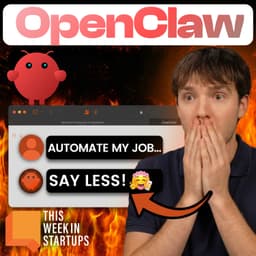
We built OpenClaw Ultron to replace 20 people at our company | E2246
This Week in Startups by Jason Calacanis · 70 min
Listen to episode →The episode demonstrates building OpenClaw Ultron—an agent suite intended to automate the work of roughly 20 employees—by combining memory, cron jobs, and discrete ‘skills’ into dashboards and scheduled agents. A major theme is running frontier LLMs locally on consumer Apple Silicon (Mac Studios/Mac Minis) to retain data sovereignty, avoid vendor lock-in, and make offline deployments practical using open-source models like KimiK 2.5. ExoLabs explains scaling strategies that cluster many Macs into ad-hoc meshes to provide cost- and power-efficient HPC and LLM hosting, while NextVisit shares early traction using AI to improve behavioral-health documentation and outcomes. The conversation also covers self-optimizing agents that detect/fix operational issues (initially with human approval), security concerns such as prompt-injection and untrusted tokens, and tradeoffs between cloud/GPU and local hardware approaches.
Key Takeaways
- 01
Practical automation is achieved by orchestrating memory, scheduled tasks, and modular skills into agent dashboards.
OpenClaw Ultron succeeds by combining persistent context (memory), cron-like scheduling, and many small skills into a single control plane so agents can perform routine production and venture-firm tasks autonomously. This architecture makes incremental automation predictable and debuggable, enabling conservative human-in-the-loop rollouts and fast iteration on which chores to offload first.
- 02
Running frontier LLMs locally on consumer Apple Silicon is now viable and strategically important.
Advances in open-source models (e.g., KimiK 2.5) and powerful, efficient Apple M-series hardware make on-device LLM hosting economically and technically practical, avoiding continuous cloud costs and third-party model changes. Local deployment preserves data sovereignty, reduces dependence on profit-seeking vendors, and gives teams control over model behavior and uptime; recommended baselines included dual Mac Studios for robust local clusters.
- 03
Clustered Mac mini/Studio meshes provide a cost- and power-efficient alternative for certain HPC and LLM workloads.
ExoLabs’ approach of scaling out many Apple Silicon machines (100+ Mac minis in some deployments) demonstrates that ad-hoc interconnects can meet throughput needs for both LLM inference and other compute-heavy tasks. For organizations with predictable, sustained workloads, this can substantially lower TCO versus cloud GPUs, leveraging RDMA-like networking and orchestration to distribute tasks across the mesh.
- 04
Self-optimization and scheduled agents can autonomously detect and remediate operational issues, accelerating reliability.
OpenClaw’s self-optimization cron jobs identified problems like skipped schedules and automatically fixed them (initially with human approval), illustrating how monitoring + agentic automation reduces manual ops burden. This pattern improves resilience and scalability, though it requires careful rollout and safeguards to prevent cascading failures from mistaken autonomous actions.
- 05
Security and trust remain critical risks—prompt injection and untrusted tokens are unresolved attack surfaces for autonomous agents.
When agents fetch internet content or act on tokens, they can be manipulated via prompt injection or malicious payloads; the episode highlights there is no silver-bullet defense yet. Teams must design strict validation, provenance checks, and conservative execution policies (and likely retain human approval for high-risk flows) while the ecosystem matures.
- 06
Verticalized AI products with measurable outcomes can achieve early traction and sustainable unit economics.
NextVisit’s early metrics (311 users, 68 paying customers, $9k MRR, CAC ~$189, LTV ~$1.7k) show that focused solutions—here, behavioral-health documentation and clinical outcomes—can convert and retain users while demonstrating ROI. This reinforces that AI scrapers/scribes combined with domain-specific workflows are compelling go-to-market plays when they reduce friction and correct real-world errors (e.g., chart mistakes).
Questions answered in this issue
Why does Reddit think AI-powered search is a strong revenue opportunity?
Reddit argues its discussion-driven content and multi-perspective answers are well-suited for LLM synthesis; usage metrics (search WAU +30%, Answers growth) show strong engagement. The company can also monetize via content licensing and potential premium AI features.
How fast has Reddit Answers grown in recent quarters?
Per the host's report, Reddit Answers grew from about 1 million weekly active users in Q1 last year to 15 million by Q4, indicating very rapid adoption. This surge supports further investment in richer, media-heavy AI responses.
What UI changes did the EU demand TikTok implement?
The Commission requested disabling infinite scroll, implementing screen-time breaks and changing the recommendation system to reduce compulsive use, especially among minors and vulnerable adults.
Who is Salt Typhoon and why is it significant?
Salt Typhoon is a China-linked hacking group accused by Norway (and described as an 'epoch defining threat' by U.S. officials) of breaching critical infrastructure and intercepting communications, underscoring persistent state-level cyberespionage risks.
What is the primary goal of building OpenClaw Ultron?
To create a single replicant agent that can perform the routine tasks of roughly 20 employees by combining 100–200 discrete skills, thereby removing chores so humans can focus on higher-value work (investor/founder relationships and content production).
How much of a producer's workload did the team expect to hand off to Ultron in 30 days?
Oliver estimated roughly 60% of his production time (if doing ~30 hours/week) could be automated conservatively within the next month of iterative work.