TL;DL AI Digest 2026-08-18
Issue
TL;DL AI Digest 2026-08-18
Distilling Deep AI Insights from Leading Podcasts
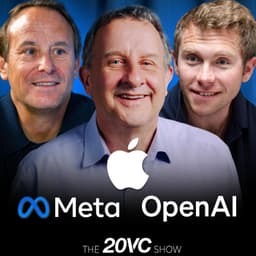
20VC: Apple Sues OpenAI | Zuckerberg Back on X and Challenging Codex and Claude Code | SK Hynix's $26BN IPO | Is Seed Investing Dead: Jason Calacanis Departs Seed for Growth | Greylock Raises New $1.5BN Fund
The Twenty Minute VC (20VC): Venture Capital | Startup Funding | The Pitch by The Twenty Minute VC · 82 min
Listen to episode →This episode is a wide-ranging discussion about the shifting AI landscape, with a strong focus on competition, pricing, and market structure. The hosts debate Apple’s lawsuit against OpenAI as potentially more strategic than purely legal, especially given OpenAI’s hardware ambitions. They also argue that AI economics should be judged by cost per completed task rather than cost per token, and that AI may become a substantial new line item in enterprise software budgets. On the competitive front, Meta’s model launch is presented as a direct attack on OpenAI and Anthropic through cheaper pricing and distribution. The conversation then broadens into venture capital, covering the changing importance of late-stage investing, the evolution of seed round math, and why the old “stay private longer” narrative no longer fully captures how value is created in AI-era companies.
Key Takeaways
- 01
Apple’s lawsuit against OpenAI may be as much about strategy as trade secrets.
The hosts suggest Apple could be using legal pressure to slow OpenAI’s hardware ambitions and increase its own leverage. This matters because it shows how major platform companies may use litigation to shape competitive dynamics, especially when a rival starts moving into devices and consumer hardware.
- 02
AI should be evaluated by cost per completed task, not just cost per token.
A model can look cheap on a token basis but still be expensive if it fails to finish real workflows efficiently. This reframing is important for enterprise buyers and builders because it ties AI value to actual output, especially in coding, enterprise automation, and workflow tools.
- 03
The biggest near-term value in AI may be in enterprise workflows and coding, not consumer chat.
The discussion argues that OpenAI’s consumer success may obscure where durable monetization is happening. Technologies like coding copilots, enterprise assistants, and task automation tools may create stronger business value than broad consumer usage, especially when they save time in high-value workflows.
- 04
AI is creating a new spending layer across software budgets.
The hosts frame AI as a potential recurring tax on software spend, with enterprises gradually allocating more budget to model usage and AI-enabled products. This is significant because it suggests AI vendors could capture a meaningful share of software economics, though the scale will still be bounded by real budget constraints.
- 05
Frontier-model competition is shifting toward cheaper pricing and distribution.
Meta’s model launch is described as a direct challenge to OpenAI and Anthropic, using low-cost tokens and broad reach to win usage. This matters because it implies that model quality alone may not decide winners; distribution, pricing, and developer adoption are becoming equally important.
- 06
Seed investing is not dead, but the ownership and capital requirements have changed.
The episode argues that top seed funds may need to write bigger checks or combine rounds to maintain meaningful ownership in exceptional companies. That shift reflects a market where the best AI and infrastructure startups may need more capital earlier, pushing venture firms to adapt their strategy and move closer to growth-stage economics.

5 AI Engineering Trends for Non-Engineers
The AI Daily Brief (Formerly The AI Breakdown): Artificial Intelligence News and Analysis by Nathaniel Whittemore · 28 min
Listen to episode →This episode explores five emerging AI engineering trends that are reshaping how non-engineers should think about AI systems. The core message is that the biggest shift is not toward unchecked agent autonomy, but toward better control systems around agents, including harnesses, permissions, context handling, evaluation, and continuous improvement. It also highlights loop engineering, where human oversight and system design are separated from the agent’s execution loop to make AI more reliable and manageable. The discussion extends into enterprise adoption through forward-deployed teams and “software factories,” where AI is used to automate parts of the software lifecycle. Finally, the episode argues that coding agents and skills-based abstractions are changing both developer workflows and how best practices get encoded into AI platforms.
Key Takeaways
- 01
AI engineering is shifting from building standalone agents to designing the systems around them.
The episode emphasizes harnesses, permissions, context management, evaluations, persistence state, and continuous improvement as the real foundation of useful AI systems. This matters because raw model capability is no longer the only differentiator; the surrounding architecture determines whether AI is safe, repeatable, and actually valuable in production. Concepts like agent harnesses and evaluation pipelines are becoming central to effective AI product design.
- 02
Loop engineering is becoming a key pattern for keeping humans in control while still using autonomous agents.
Instead of letting agents run freely, the episode describes a separation between the agent’s execution loop and the human-managed outer loop that sets goals, reviews outputs, and improves performance over time. This is significant because it creates a practical balance between automation and oversight. The idea of “better loops” reframes the future of AI as more structured collaboration rather than full autonomy.
- 03
Enterprise AI is moving toward structured internal systems, including forward-deployed teams and software factories.
The discussion suggests that companies are adopting AI through specialized teams and repeatable workflows that automate pieces of the software lifecycle. This matters because enterprise value often comes from operationalization, not experimentation. The “software factory” concept points to a future where AI helps generate, test, deploy, and maintain software in a more industrialized way.
- 04
Coding agents are increasingly replacing the IDE as the primary interface for software creation.
The episode notes that chat-based workflows are becoming where significant code is initiated, which changes the center of gravity from traditional development environments to conversational agents. This is important because it changes how developers interact with tools and how work gets started. Technologies and concepts like coding agents, chat UX, and AI-assisted programming are moving from novelty to default workflow.
- 05
Skills are emerging as a core abstraction in agent platforms.
Rather than relying on prompts alone, agent systems are beginning to package best practices, workflows, and quality gates into reusable skills. This is significant because it lets organizations encode expertise once and apply it consistently across many tasks. Skills become a scalable way to distribute human know-how, improve quality, and reduce variability in agent output.
- 06
The highest-impact AI users treat AI as a reasoning partner, not just a prompt-response tool.
The episode frames effective AI use as collaborative thinking, where users guide, challenge, and refine the system rather than simply issuing commands. This matters because it explains why some users get outsized value from AI: they use it to extend judgment, not replace it. The concept also connects to better prompting, iterative review, and human-AI co-reasoning.
Also in this issue
The Twenty Minute VC (20VC): Venture Capital | Startup Funding | The Pitch
20VC: Apple Sues OpenAI | Zuckerberg Back on X and Challenging Codex and Claude Code | SK Hynix's $26BN IPO | Is Seed Investing Dead: Jason Calacanis Departs Seed for Growth | Greylock Raises New $1.5BN Fund
a16z Podcast
Can Anyone Catch NVIDIA? | The Future of Chips and Infrastructure

Can Anyone Catch NVIDIA? | The Future of Chips and Infrastructure
a16z Podcast by a16z · 65 min
Listen to episode →This episode focuses on how the AI industry is shifting from a model-centric race to an infrastructure-centric one, where chips, data centers, power, networking, and deployment speed increasingly determine who can scale profitably. The conversation examines NVIDIA’s durable advantages and why copying its chip strategy is not enough to compete, especially given its software, supply-chain, memory, and time-to-market edge. It also explores the rise of custom silicon from hyperscalers like Google, Amazon, and Meta, which can justify in-house chips because of their massive captive workloads. Another major theme is AI economics: pricing, routing, and product design are becoming core to monetization, with systems like OpenAI’s router helping allocate queries to cheaper or more expensive models depending on value. The discussion closes with broader industry constraints and strategy questions, including export controls, China’s compute access, Intel’s operational struggles, and whether faster infrastructure deployment can justify higher non-chip costs.
Key Takeaways
- 01
AI competition is increasingly being won or lost on infrastructure economics, not just model quality.
The episode argues that chips, power, networking, data centers, and deployment logistics now shape who can scale AI profitably. This matters because frontier models only create durable advantage if the underlying compute stack can be expanded fast enough and at acceptable cost; GPUs, HBM, and data-center power availability are now strategic constraints.
- 02
OpenAI’s router strategy shows that cost management is becoming part of the product itself.
By sending low-value queries to cheaper models and reserving expensive reasoning for higher-value requests, the model stack can optimize economics at the user-request level. This is significant because it reframes inference from a fixed-cost service into a dynamic system where routing, pricing, and model selection directly affect margin and user experience.
- 03
AI is creating enormous value, but current players may be capturing less of it than they should.
The conversation suggests that the economic value generated by AI may far exceed what model labs and infrastructure providers currently monetize. This gap matters because it implies the industry is still early in finding sustainable business models, especially for commerce-like actions, enterprise workflows, and agentic products.
- 04
Custom silicon is a real threat to NVIDIA only for companies with enough scale and captive demand.
Google, Amazon, and Meta can justify internal chip efforts because they control large, predictable workloads and can optimize around their own supply chains. This makes custom silicon viable for hyperscalers, but not for most startups, since the economics depend on massive volume and deep systems integration.
- 05
Competing with NVIDIA requires a step-function improvement, not an incremental alternative.
The speakers emphasize that NVIDIA’s moat spans networking, software, process-node access, HBM supply, ramp speed, and execution discipline, so a rival must be dramatically better—roughly 5x in some dimension—to matter. This is a reminder that in AI hardware, the winning product is the whole system, not just the GPU die.
- 06
In AI data centers, it can be rational to overspend on non-chip infrastructure if it accelerates deployment.
Because GPUs are the dominant cost, paying more for cooling, backup power, or generators can be justified if it gets clusters online months earlier. The discussion around mobile chillers and expensive generators illustrates how time-to-market can outweigh capex efficiency when the opportunity cost of delayed training or inference capacity is so high.
Also in this issue
The Twenty Minute VC (20VC): Venture Capital | Startup Funding | The Pitch
20VC: Apple Sues OpenAI | Zuckerberg Back on X and Challenging Codex and Claude Code | SK Hynix's $26BN IPO | Is Seed Investing Dead: Jason Calacanis Departs Seed for Growth | Greylock Raises New $1.5BN Fund
The AI Daily Brief (Formerly The AI Breakdown): Artificial Intelligence News and Analysis
5 AI Engineering Trends for Non-Engineers
Questions answered in this issue
Why do the hosts think the Apple lawsuit could affect OpenAI’s hardware plans?
They suggest the lawsuit could create leverage for Apple and raise the cost of proceeding with the hardware initiative. In their view, it may also force OpenAI to slow down or reconsider the project altogether.
What metric do the hosts think should replace cost-per-token when evaluating AI systems?
They argue for cost per completed task. The point is that a model should be judged by how efficiently it solves an actual workflow, not by its token price in isolation.
What is the biggest shift in AI engineering highlighted in this episode?
The biggest shift is from optimizing individual agents to designing the broader systems around them: harnesses, loops, skills, and enterprise controls. The episode emphasizes that autonomy works best when it is structured and supervised.
Why does the episode say AI engineers have a six-month head start?
Because engineers tend to adopt new interaction patterns and tools before the rest of the market, giving observers an early view of where AI is heading. The host argues non-engineers can learn a lot by watching what engineers are doing now.
Why does Dylan think NVIDIA is so hard to compete with?
Because NVIDIA’s edge is not just the chip, but also networking, memory access, process node access, supply-chain leverage, software, and speed to market. A competitor would need a large step-function advantage to overcome those combined benefits.
How does the router help OpenAI monetize free users?
It lets OpenAI send low-value queries to cheaper models and high-value queries to more capable or agentic paths. That creates room for take rates on commerce-like actions such as shopping, booking, and lead generation.
Explore