AI Agents Rewriting SaaS Economics
Issue
AI Agents Rewriting SaaS Economics
Distilling Deep AI Insights from Leading Podcasts
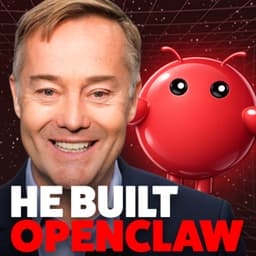
Behind the Scenes with an early OpenClaw contributor! | E2252
This Week in Startups by Jason Calacanis · 82 min
Listen to episode →The episode dives into OpenClaw, an open-source agent platform for building long-running AI replicants that automate knowledge work, with a founder/contributor perspective on governance, tooling and rapid prototyping. Guests discuss the recent leap in agent capabilities enabled by tool-calling, subagents and long-running tasks, and contrast cloud vs. local model execution (Mac mini/Mac Studio and hobbyist hardware) for privacy, speed and reliability. The show also covers business and ethical angles: Anthropic/Claude's explosive revenue and valuation, the Pentagon's push on guardrail removal, and whether agentization will compress the SaaS market. Practical demos include a pocket OpenClaw device prototyped cheaply and quickly, plus thoughts on persona-driven voice products and the long-term outlook for brain-computer interfaces (invasive vs non-invasive). Open-source governance friction—thousands of PRs and semi-formal maintainer triage—is highlighted as a scaling challenge for fast-growing projects.
Key Takeaways
- 01
OpenClaw makes it straightforward to create long-running, integrated AI agents that automate recurring knowledge-work.
OpenClaw provides an open-source framework to compose agents, subagents and tool integrations (email, calendar, messaging, bookkeeping), enabling automation of multi-step workflows. This lowers the barrier for developers to build persistent AI 'replicants' that can manage tasks over time rather than single calls, accelerating practical agent applications.
- 02
Recent model and tooling advances (tool-calling, subagents, long-running tasks) produced a step-change in agent capabilities over the past 12–18 months.
Features like structured tool-calls and the architectural pattern of spawning background subagents let systems parallelize work and avoid blocking, improving responsiveness and robustness. These patterns directly enable more complex automations and make agentized products commercially viable, but they increase orchestration and context-management complexity.
- 03
Running models and agents locally is increasingly attractive for privacy, latency and reliability reasons.
Using local inference on devices such as Mac mini/Mac Studio or small hobbyist hardware removes third-party telemetry, reduces network latency and avoids cloud VM fragility. For many users and prototypes, local setups are now performant enough to be a preferable tradeoff compared with cloud-hosted APIs—especially for sensitive data or offline-first experiences.
- 04
Open-source governance scales imperfectly: high contribution velocity creates triage bottlenecks despite role-based maintainers.
Projects like OpenClaw receive thousands of PRs and rely on semi-formal maintainers owning subsystems and community channels (Discord/GitHub) for routing. While this chaotic-but-functional approach fosters rapid innovation, it introduces backlog, quality-control risk and onboarding friction that can slow critical fixes or coherent product direction.
- 05
Cheap, fast prototyping enables device-first UX experiments (pocket assistants, persona-driven voice products).
The episode showcased a pocket OpenClaw device built in a weekend for about $100, demonstrating accessible hardware + software stacks for hobbyists and startups. This lowers the cost of exploring form factors and interaction models—voice-first assistants, kid-focused personas, or single-purpose appliances—potentially unlocking new product categories beyond traditional SaaS.
- 06
BCI prospects vary widely: invasive approaches promise richer signals but require long timelines and medical tradeoffs; non-invasive methods are noisier and less likely to deliver high-bandwidth interaction soon.
The conversation contrasts invasive BCIs (surgical, high-fidelity signals) with non-invasive sensors (safe but noisy), concluding meaningful neural interfaces for broad consumer use are likely a decade-plus away. This tempers hype around brain-driven agent control while recognizing distinct research and application pathways (medical vs consumer).
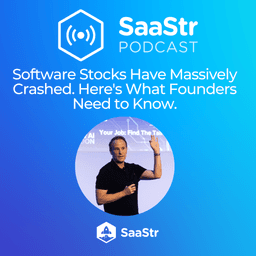
SaaStr 843: Software Stocks Have Massively Crashed. Here's What Founders Need to Know.
The Official SaaStr Podcast: SaaS | Founders | Investors by SaaStr · 43 min
Listen to episode →The episode explores how the crash in software stocks and shifting investor expectations are reshaping SaaS strategy, fundraising, and exits. Jason Lemkin argues that meaningful AI adoption is proven by re-accelerated growth or materially improved unit economics, not by shipping demoable agents. He describes how AI agents are already replacing human labor across GTM and support — even closing large deals autonomously — while low-code / "vibe-coding" is flooding markets with demo-ready clones that make durable differentiation and go-to-market harder. The show also breaks down the economics of large events (very high fixed costs but strong upside once scale is reached) and why private equity is increasingly wary of legacy B2B unless AI can show topline lift. Practical implications for founders include focusing on ROI-driven features, careful capital allocation for events, and leaning into AI discoverability and automation to compete.
Key Takeaways
- 01
Re-accelerated growth is the true signal of meaningful AI adoption.
Founders and investors should judge AI efforts by measurable topline acceleration or materially improved unit economics, not by the presence of agents or flashy demos. This shifts product priorities toward features that drive revenue or retention and away from vanity demos; it also affects fundraising and valuation conversations where evidence of growth re-acceleration is now table stakes.
- 02
AI agents are already replacing human work in GTM and support and can directly close revenue.
Agents can perform follow-ups, reactivation, ticket triage, and other repetitive tasks at scale and 24/7, improving engagement metrics and reducing headcount. The practical result is lower operating costs and faster, sometimes superior, execution (e.g., an agent closing a $100K deal), which changes hiring plans, compensation models, and how startups measure channel effectiveness.
- 03
Low-code / "vibe-coding" is drastically lowering the bar to market-ready product demos, increasing competition.
Tools that enable rapid, agentized app creation produce many polished clones, making winner-takes-most markets more volatile and GTM differentiation harder. To survive, companies must demonstrate clear ROI, own unique data or workflows, or target niche use cases where they materially replace human costs — otherwise product parity will commoditize pricing and acquisition.
- 04
Large events have a high fixed-cost threshold but can be highly profitable once scaled.
Running big conferences or events typically requires clearing a multi-million dollar 'nut' ($10–$20M), creating significant upfront risk for smaller teams. If that threshold is reached through sponsorships, ticketing, and scale, events become cash-generative and strategic, but founders should validate sponsorship economics and product-market fit before making the capital bet.
- 05
Investor appetite (including PE) has changed: AI-driven re-acceleration is often a precondition for M&A or PE interest in B2B assets.
Private equity and strategic buyers are wary of legacy B2B companies that can't prove AI-boosted growth or cost takeout, meaning sellers may need to demonstrate AI impact to get favorable exits. This raises the bar for incumbents and forces founders to prioritize measurable AI outcomes to remain attractive to acquirers or public markets.
Questions answered in this issue
What is OpenClaw and what does it enable?
OpenClaw is an open-source platform for building AI agents (replicants) that perform long-running tasks and integrations (email, calendar, bookkeeping, messaging). It enables users to automate recurring knowledge-work and compose subagents/skills.
Why are people moving agents/models to local machines (Mac mini / Mac Studio)?
Local runs improve responsiveness and reliability, reduce dependence on cloud VMs, and avoid sending personal data to third-party providers (mitigating telemetry/training use). For many, the tradeoff favors privacy and speed.
What should founders use as the primary indicator that their AI work is meaningful?
Demonstrable re-acceleration of growth (revenue/ARR) tied to AI deployments — not just building an agent or publishing a demo. Investors and leadership want to see topline lift or materially improved unit economics.
Are event businesses worth entering today given their costs and risks?
Large events can be highly profitable once you clear a high fixed cost threshold ($10–$20M), but they carry extreme upfront risk; smaller organizations should be cautious and focus on product‑market fit or sponsorship economics before scaling.